Guangzhou Attractions 9 min read
Guangzhou Sacred Heart Cathedral: Architecture, History & Visiting Guide
Discover Guangzhou's Sacred Heart Cathedral (Shishi): an all-granite Gothic cathedral with twin spires, rose windows, 25-year construction history, and visiting tips.
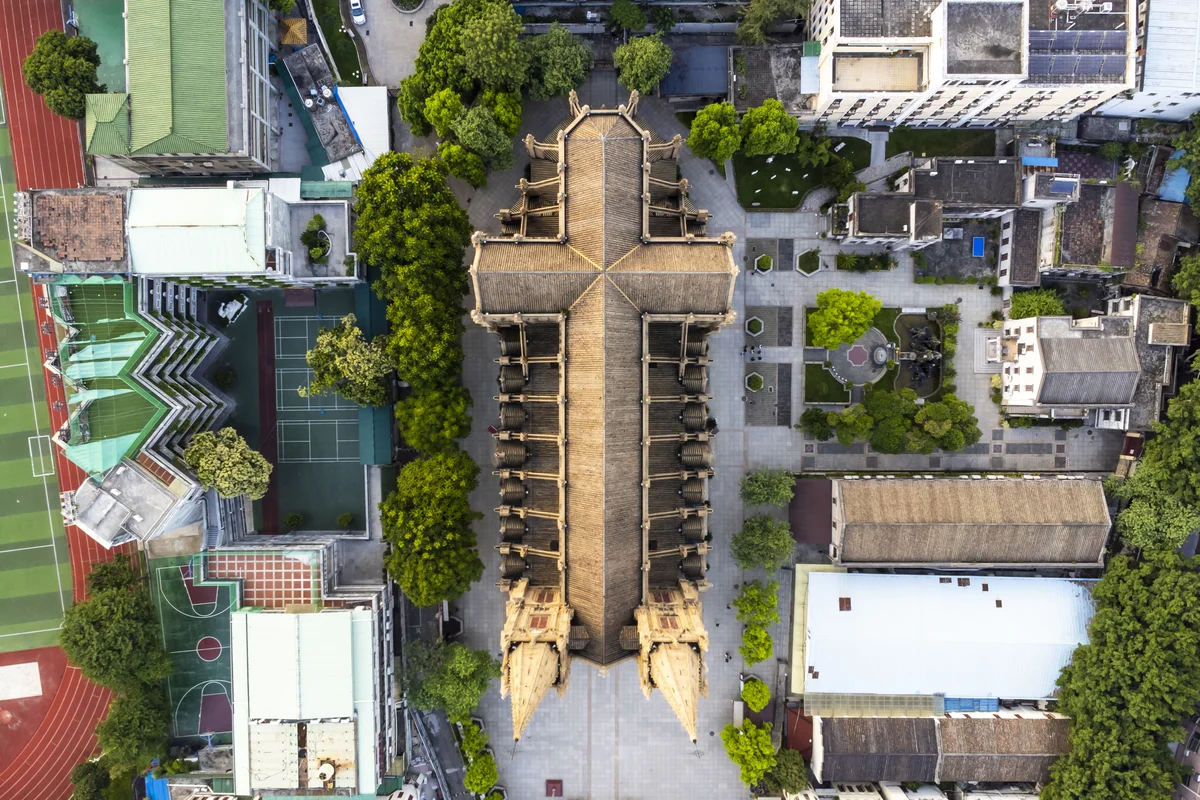
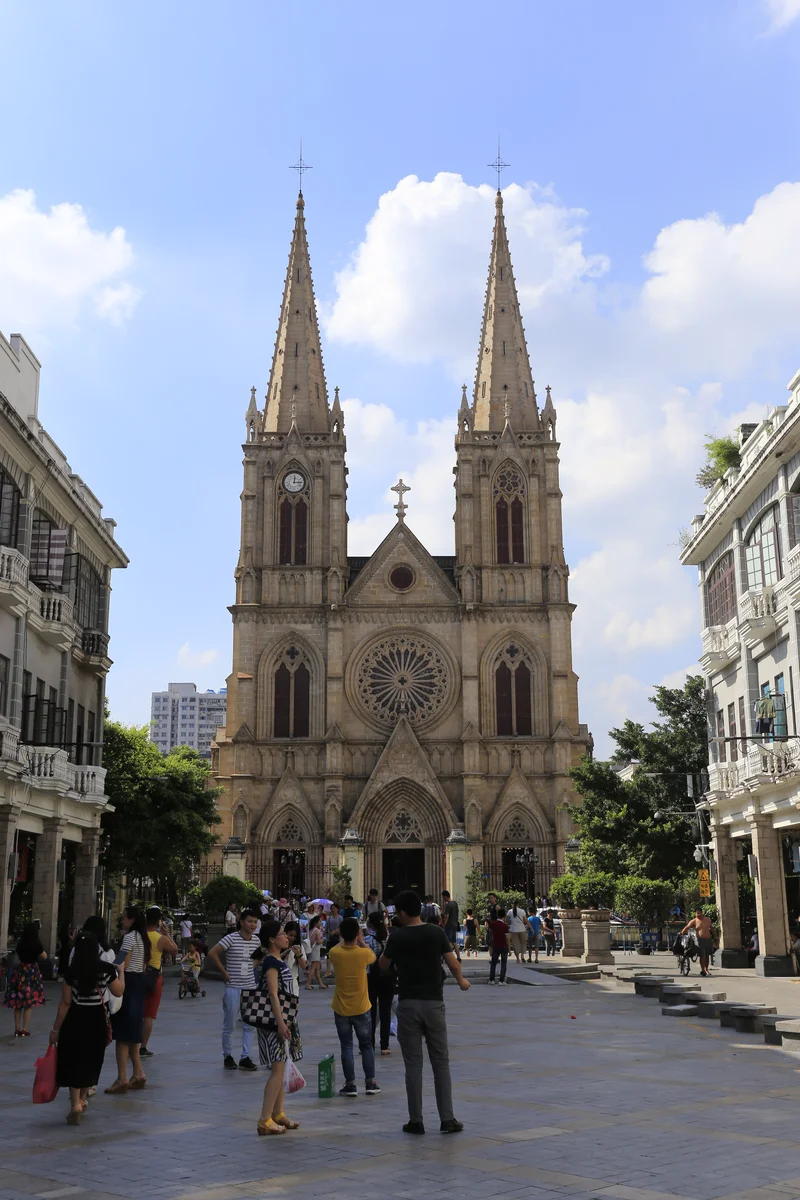
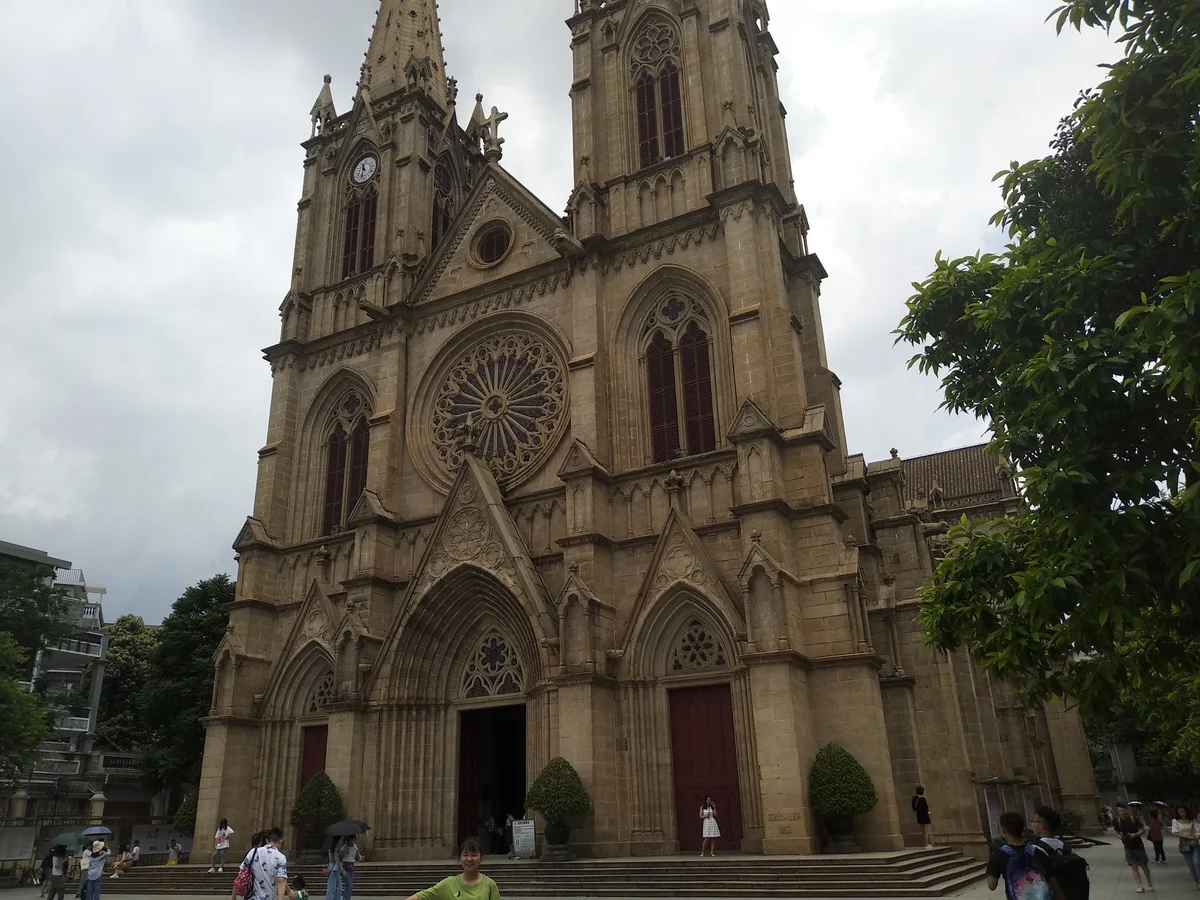
In the vibrant merchant quarter of Guangzhou's Yuexiu District, just a few blocks north of the Pearl River, rises an awe-inspiring vision of High Medieval Europe. Surrounded by the sensory whirlwind of Yide Road's dried seafood stalls and wholesale toy emporiums, Guangzhou Sacred Heart Cathedral (广州圣心大教堂)—known affectionate by locals simply as Shishi (石室, literally "Stone Room")—punches the southern sky with twin 58.5-meter granite spires.
Completed in 1888 after a grueling quarter-century of manual construction, Shishi holds an exceptional place in global architectural history. It is one of only four twin-spire all-granite Gothic cathedrals built anywhere in the world, sharing this rare engineering distinction with Notre-Dame de Paris, Westminster Abbey, and Cologne Cathedral. From its soaring stone rib vaults and delicate flying buttresses to its vivid rose windows, the cathedral stands as a monument of transatlantic craft, where Parisian draftsmen and Hakka stonemasons joined forces to build a masterpiece out of solid granite.
Introduction to Shishi: The All-Granite Gothic Marvel
Covering a total building footprint of 2,754 square meters, the cathedral measures 78.69 meters from east to west and 35 meters across its transepts. Unlike many late-19th-century colonial churches that relied on brick skeletons faced with stone veneer or cement plaster, every single structural element of Shishi—its foundations, exterior walls, soaring nave columns, pointed rib vaults, and hollow spire cupolas—was hand-carved and laid in solid granite.
This uncompromising construction method earned it the nickname "Notre-Dame of the Far East." In 1996, the State Council of the People's Republic of China designated the cathedral as a Major National Historical and Cultural Site, cementing its status as one of southern China's foremost sacred treasures.
From Viceroy Yamun to Sacred Heart: 25 Years of Construction
The ground upon which the cathedral rests has witnessed tectonic shifts in modern Chinese history. During the Qing Dynasty, this expansive compound at Jiubuqian served as the official Yamun (headquarters) of the Viceroy of Liangguang, who governed the imperial provinces of Guangdong and Guangxi.
Historical Origins and Foundation on Ruined Ground
During the Second Opium War in 1857, British and French joint expeditionary forces bombarded Guangzhou, reducing the palatial Viceroy's residence to smoldering rubble. Following the Treaty of Beijing in 1860, French missionary Philippe François Zéphirin Guillemin (明稽章), Apostolic Prefect of Guangdong, invoked treaty provisions to claim the vacant compound site for the Catholic mission.
French architects Léon Vauthrin and Achille-Antoine Hermitte drew up the design blueprint modeled on classical French Gothic basilicas. On June 18, 1863—the Feast of the Sacred Heart of Jesus—Bishop Guillemin presided over a grand cornerstone-laying ceremony. Because Napoleon III provided diplomatic and financial backing, two foundation stones were blessed: one inscribed "Jerusalem 1863" using earth brought from the Holy Land, and another inscribed "Rome 1863" utilizing stone imported from the catacombs of Rome.
Master Mason Cai Xiao and the Feat of Granite Engineering
Building an all-stone cathedral in Guangzhou's humid, riverbank subtropical geology proved an unprecedented logistical challenge. Over hundreds of thousands of granite blocks were quarried from Ngau Tau Kok and Cha Kwo Ling in Kowloon, Hong Kong. Each stone was hand-chiseled on the coast, loaded onto heavy wooden sailing junks, navigated across the Pearl River estuary through Lingdingyang, and offloaded at the Guangzhou wharves.
Within several years, tropical diseases, typhoons, and cultural miscommunication led both French supervising engineers to resign and return to Europe. The monumental task fell to a master stonemason from Jiexi, Guangdong, named Cai Xiao (蔡孝).
Cai Xiao demonstrated ingenious adaptation. In place of European lime mortar that degraded quickly under subtropical rains, he formulated a traditional Lingnan mortar blend using boiled sticky rice paste, tung oil, lime, and crushed granite sands. This ancient Chinese mortar hardened into an elastic, impervious binder that interlocked the multi-ton granite blocks securely. Utilizing tall Chinese fir scaffolding and manual hand-cranked pulleys, Cai Xiao directed hundreds of Cantonese masons for more than a decade, successfully crowning both 58.5-meter spires without modern machinery. The cathedral was finally consecrated in 1888, after 25 years of relentless labor and an expenditure of 400,000 French francs.
Gothic Architectural Masterclass and Lingnan Adaptations
Viewed from the air or street level, Shishi presents an impeccable demonstration of Gothic structural principles, combining soaring verticality with airy structural lightness.
Twin 58.5-Meter Spires and the 7-Meter Rose Window
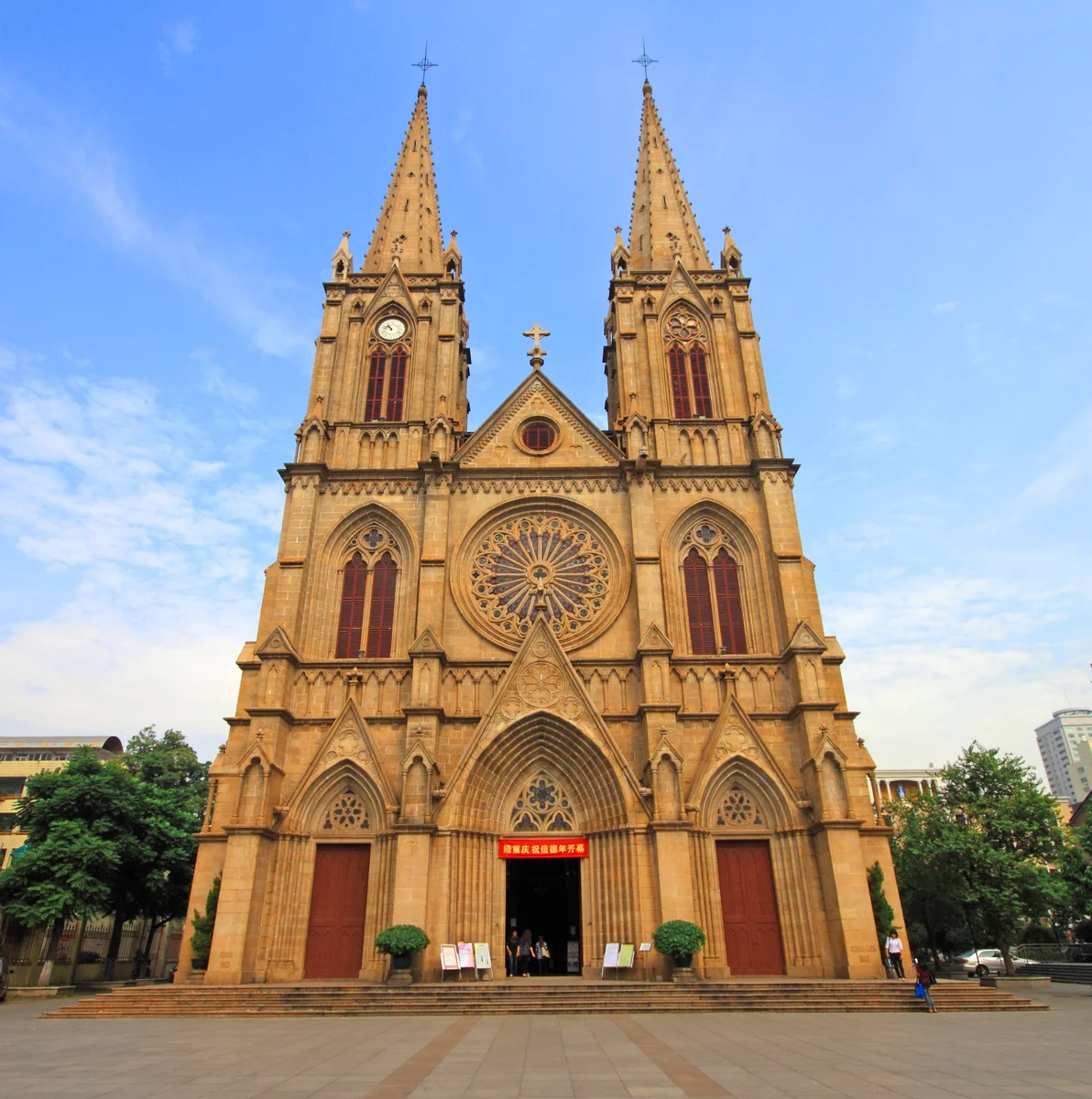
The cathedral's west facade is framed by two symmetrical octagonal spires that taper skyward. The three-tiered front entrance includes deeply recessed pointed portals carved with intricate floral archivolts. Directly above the central portal sits a spectacular 7-meter-diameter rose window with openwork stone tracery radiating from a central focal point.
The twin towers served distinct civic and ecclesiastical purposes:
- East Tower (Clock Tower): Originally equipped with a massive mechanical clock face that kept time for the surrounding old quarters of Guangzhou.
- West Tower (Belfry): Houses five magnificent bronze bells cast by specialized bellfounders in Lyon, France, shipped across the oceans to Guangzhou in the 1880s.
Flying Buttresses and Rib-Vaulted Nave
To support the high 28.2-meter nave vault without massive stone walls collapsing outward, Hermitte and Cai Xiao employed an external skeleton of flying buttresses (飞扶壁). Curved granite arches spring from the clerestory walls across the aisle roofs to anchor into heavy external vertical piers. This skeletal load-bearing system allowed masons to replace thick stone walls with expansive lancet windows.
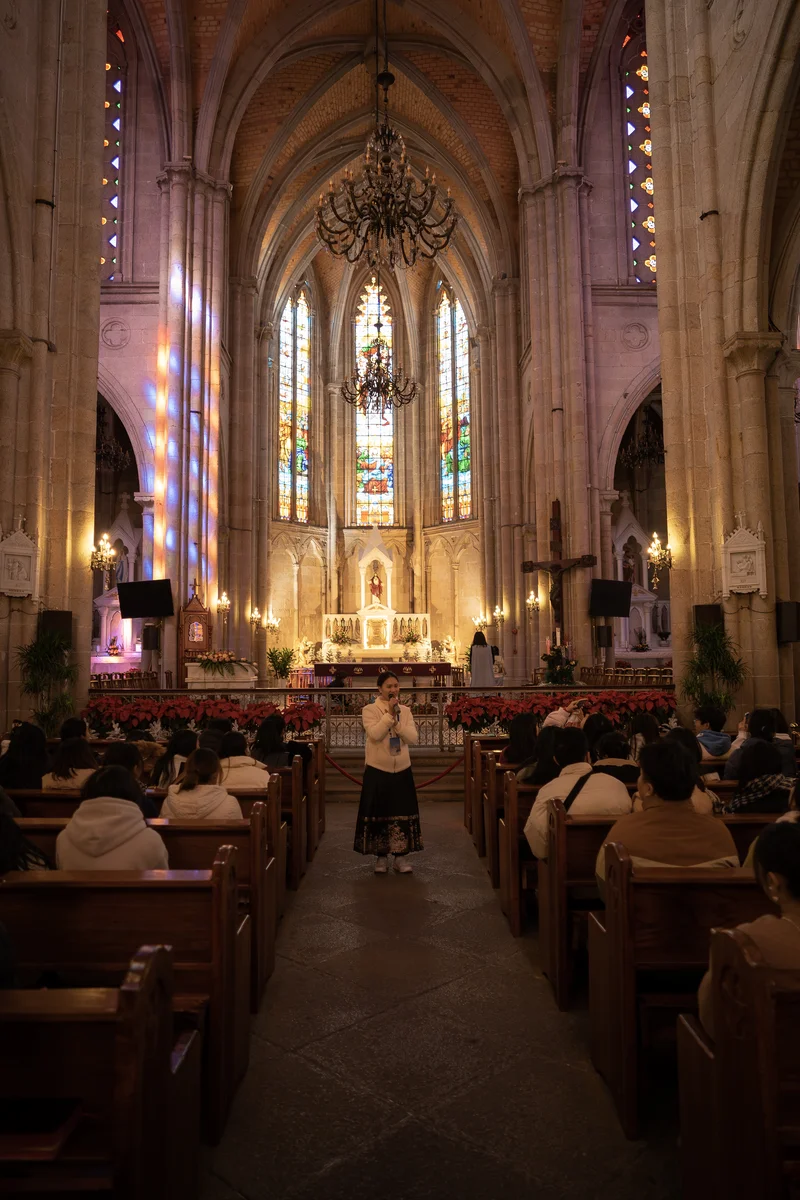
Inside, 24 monolithic compound columns support quadripartite ribbed cross-vaults. Pointed arches guide the eye upward, evoking the spiritual sensation of divine light descending into the tranquil nave.
Stained Glass Windows and French Bronze Bells
The interior's luminous atmosphere is created by dozens of lancet windows. The original 19th-century French stained glass suffered heavy damage during Japanese air raids in World War II and subsequent political unrest. During an extensive municipal restoration between 2004 and 2006, master stained-glass craftsmen from the Philippines were commissioned to handcraft authentic leaded colored glass using historical biblical iconography. When the southern afternoon sun strikes the west windows, rich blues, rubies, and golden hues illuminate the gray granite pavement in mesmerizing patterns.
Sacred Haven in a Worldly Market: The Yide Road Contrast
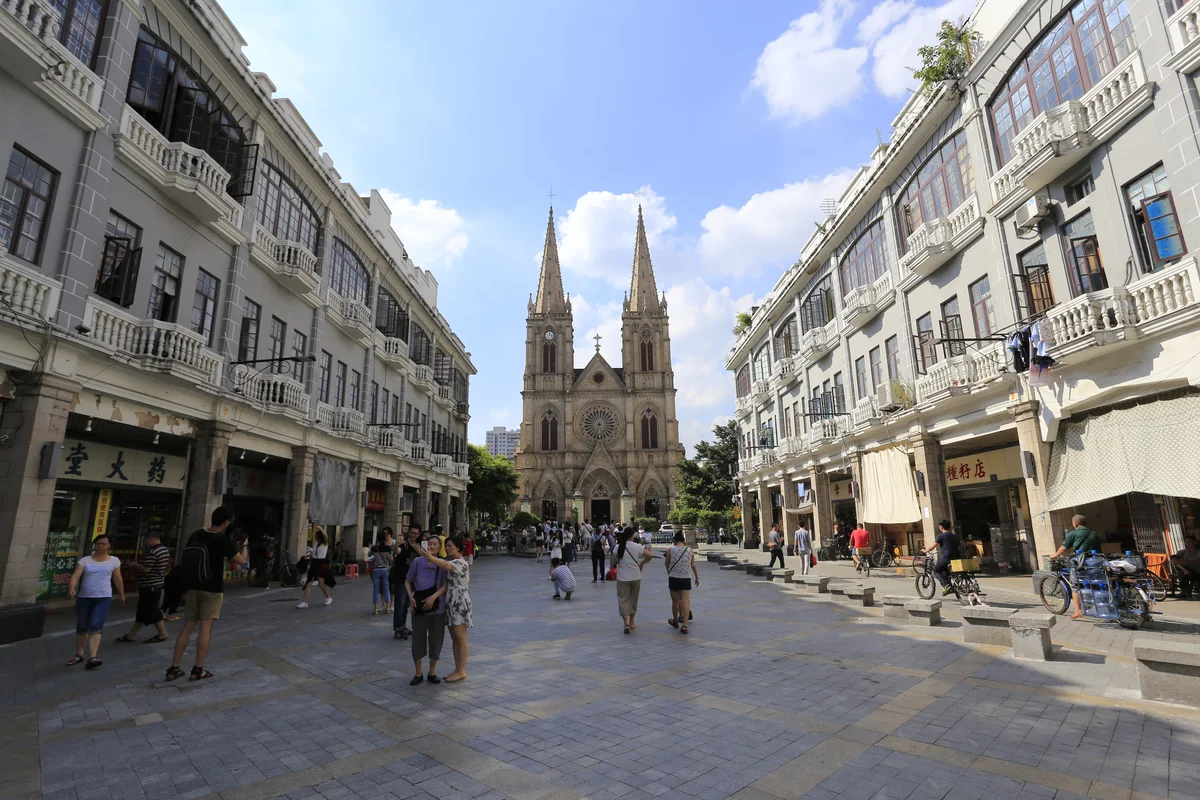
What makes a visit to Sacred Heart Cathedral uniquely unforgettable is its surreal urban context. While European cathedrals often command vast, sanitized plazas, Shishi is embedded right in the beating commercial belly of Guangzhou's historic Yide Road.
Stepping out of the plaza gates plunges you immediately into Asia's premier wholesale dried seafood and festive goods market. Porters push handcarts stacked high with cartons of dried scallops, abalone, and sea cucumber; shopkeepers haggle loudly beneath Republican-era Qilou arcades; and red festival lanterns hang in vibrant rows. Yet step through the wrought-iron cathedral gate, and that sensory frenzy vanishes instantly into reverent quiet, accompanied by the cooing of pigeons perched on granite buttresses and the gentle rustle of courtyard palms.
Visitor Guide: Opening Hours, Dress Code, and Mass Times
Because Shishi is an active house of worship and the cathedral seat of the Catholic Archdiocese of Guangzhou, travelers must respect scheduled visitor windows and strict etiquette.
| Item | Details |
|---|---|
| Admission Fee | Free entry (No advance booking required for general tourists) |
| Public Visiting Hours | Tuesday to Friday: 9:00 AM – 11:30 AM, 2:30 PM – 5:00 PM Saturday: 9:00 AM – 2:30 PM Sunday: 1:00 PM – 2:30 PM Closed Mondays |
| Dress Code | Modest clothing required. Sleeveless tops, miniskirts, shorts above the knee, and flip-flops are strictly prohibited. Modesty wrap aprons are available at the entrance if needed. |
| Photography Rules | Photography without flash is permitted during public visiting hours. Photography and videography are strictly prohibited during liturgical services and Mass. |
Public Visiting Hours and Etiquette
Please enter in silence and turn mobile devices to vibrate. Hats and caps must be removed before crossing the threshold. Visitors should not wander into the sanctuary area behind the main communion rail.
Mass Schedule in Multiple Languages
The cathedral conducts regular liturgical celebrations catering to both local parishioners and Guangzhou's large international community:
- Cantonese Mass: Weekday mornings at 6:45 AM; Sunday mornings at 7:00 AM.
- Mandarin Mass: Saturday evenings at 7:30 PM; Sunday mornings at 8:30 AM and 10:30 AM.
- English Mass: Sundays at 3:30 PM (widely attended by international expatriates, business travelers, and students).
- Korean Mass: Saturdays at 4:00 PM.
How to Get to Sacred Heart Cathedral and Nearby Itineraries
The cathedral's prime location in western Yuexiu makes it exceptionally convenient to incorporate into a broader walking tour of Guangzhou's Old Central Axis.
Metro and Transit Connections
- Via Yide Road Station (Line 6): Take Exit A, turn right onto Yide Road, and walk east along the arcade street for approximately 400 meters (about 5 minutes).
- Via Haizhu Square Station (Line 2 & Line 6): Take Exit B2, walk west along Yide Road past the dried seafood wholesale markets for about 550 meters (roughly 8 minutes).
- Taxis / Ride-Hailing: Note that Yide Road is a narrow, heavily congested one-way corridor during commercial business hours (9:00 AM – 6:00 PM). It is often much faster to be dropped off along Jiefang South Road or Changdi Da Ma Lu and complete the final 200 meters on foot.
Walking Route Along Haizhu Square and the Pearl River
Combine your visit with these historic highlights within comfortable walking distance:
- Yide Road Wholesale Markets: Explore the vibrant covered arcades selling spices, teas, and holiday lanterns right outside the cathedral gates.
- Haizhu Square (海珠广场): Walk 500 meters east to see the Guangzhou Liberation Monument and the iconic 1933 Haizhu Bridge, Guangzhou's very first bridge over the Pearl River.
- Changdi Waterfront Promenade: Head 300 meters south to Changdi Da Ma Lu along the riverbank, home to Republic-era neoclassical banks, Western customs houses, and historic teahouses.
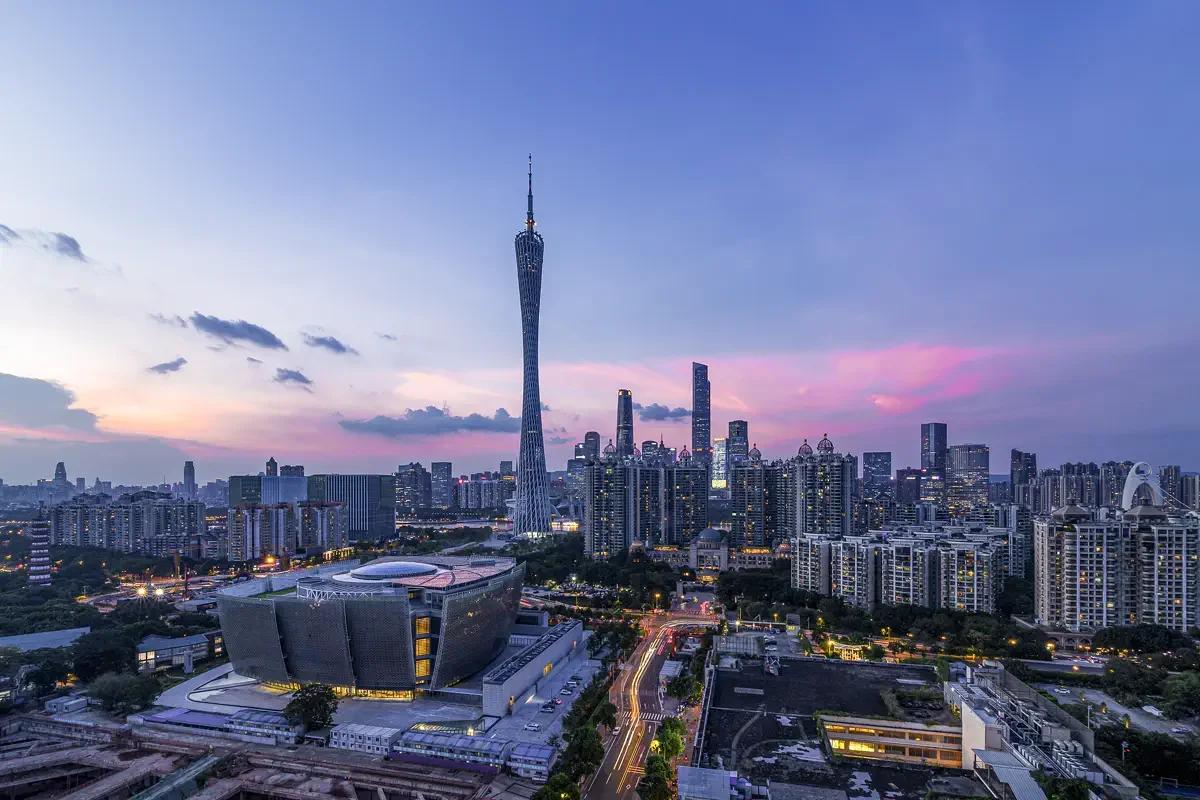
- Easy Transit Extensions: Board Metro Line 6 westbound to reach Yongqing Fang and Shamian Island, or transfer to Line 1 to marvel at the Lingnan wood and pottery carvings of Chen Clan Ancestral Hall. Alternatively, take an evening Pearl River Night Cruise from nearby Tianzi Pier to view Canton Tower ablaze in colors.
Frequently Asked Questions About Sacred Heart Cathedral
Is Sacred Heart Cathedral open on Mondays?
No. Sacred Heart Cathedral is completely closed to tourists and the public on Mondays for routine architectural maintenance, structural inspection, and clerical duties.
Can international tourists attend the Sunday English Mass?
Yes. International travelers and non-parishioners of all backgrounds are welcome to attend the Sunday English Mass at 3:30 PM. Please arrive 15 minutes early to secure seating in the nave, and refrain from taking photographs during the liturgy.
Why is the cathedral called "Shishi" (Stone Room)?
In Cantonese vernacular, "Shishi" translates literally to "Stone Room." Because the building was erected entirely with solid granite blocks from bedrock foundation to the tip of its towers, local residents coined the descriptive name Shishi, which has remained the city's colloquial title for over a century.
Are bags or luggage checked at the entrance?
Yes. A security screening post is located at the front courtyard gate. Large luggage, oversized backpacks, open liquids, drones, and pets are not permitted inside the sanctuary.