Guangzhou Attractions 12 min read
Shamian Island Guangzhou: Walking Guide, Colonial Architecture & Travel Tips
Discover Shamian Island in Guangzhou: historic European architecture, Our Lady of Lourdes Catholic Church, Christ Church, banyan-lined avenues, White Swan Hotel, and local dining tips.
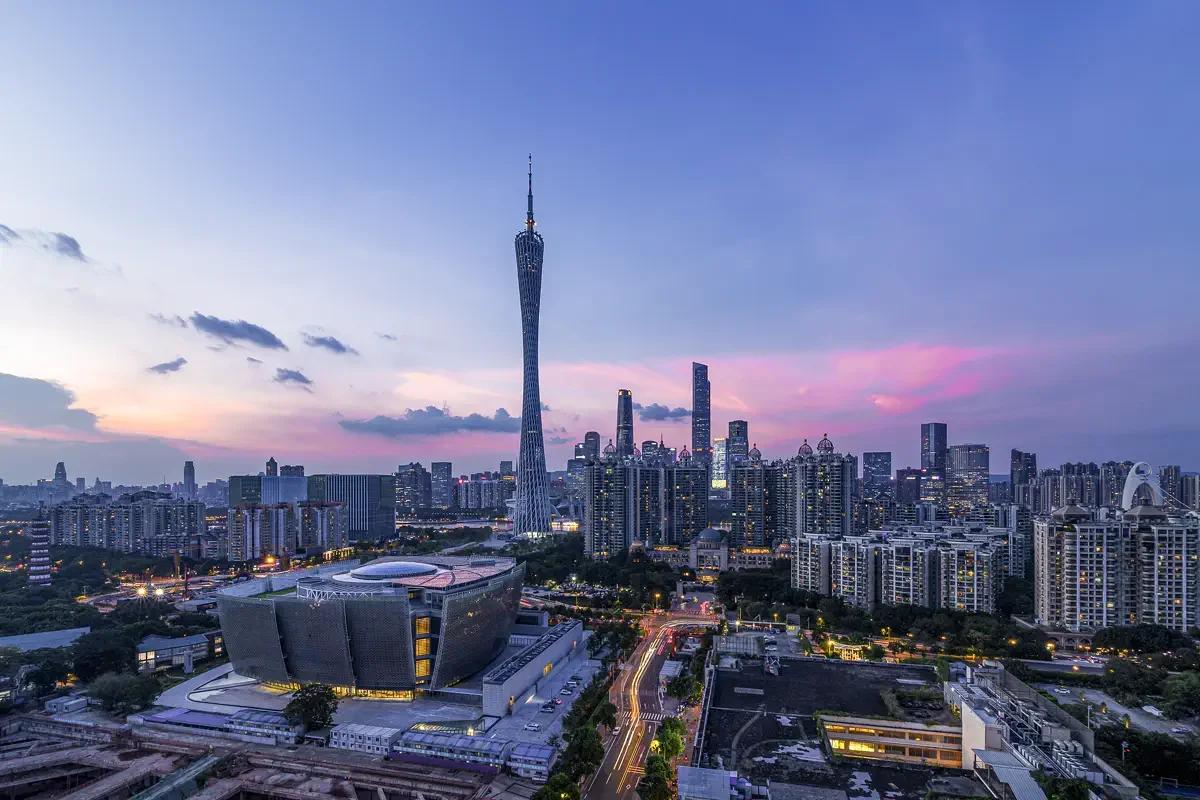
In the southwestern pocket of Guangzhou's historic Liwan District, where three branches of the Pearl River converge into the sweeping waters of Bai'etan (White Swan Pool), lies Shamian Island (沙面岛). Covering just 0.3 square kilometers (roughly 74 acres), this peaceful pedestrian enclave stands in dramatic contrast to the skyscraper-studded skyline of Tianhe and the neon-lit verticality of Canton Tower.
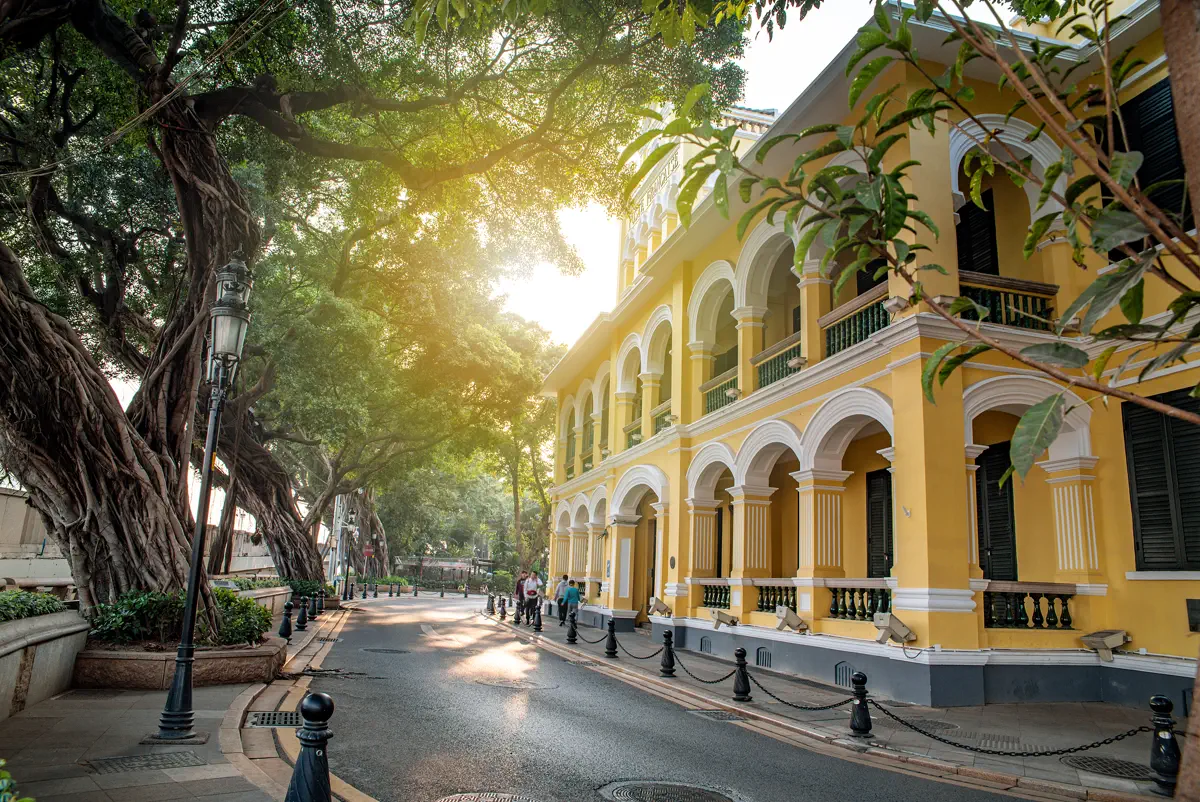
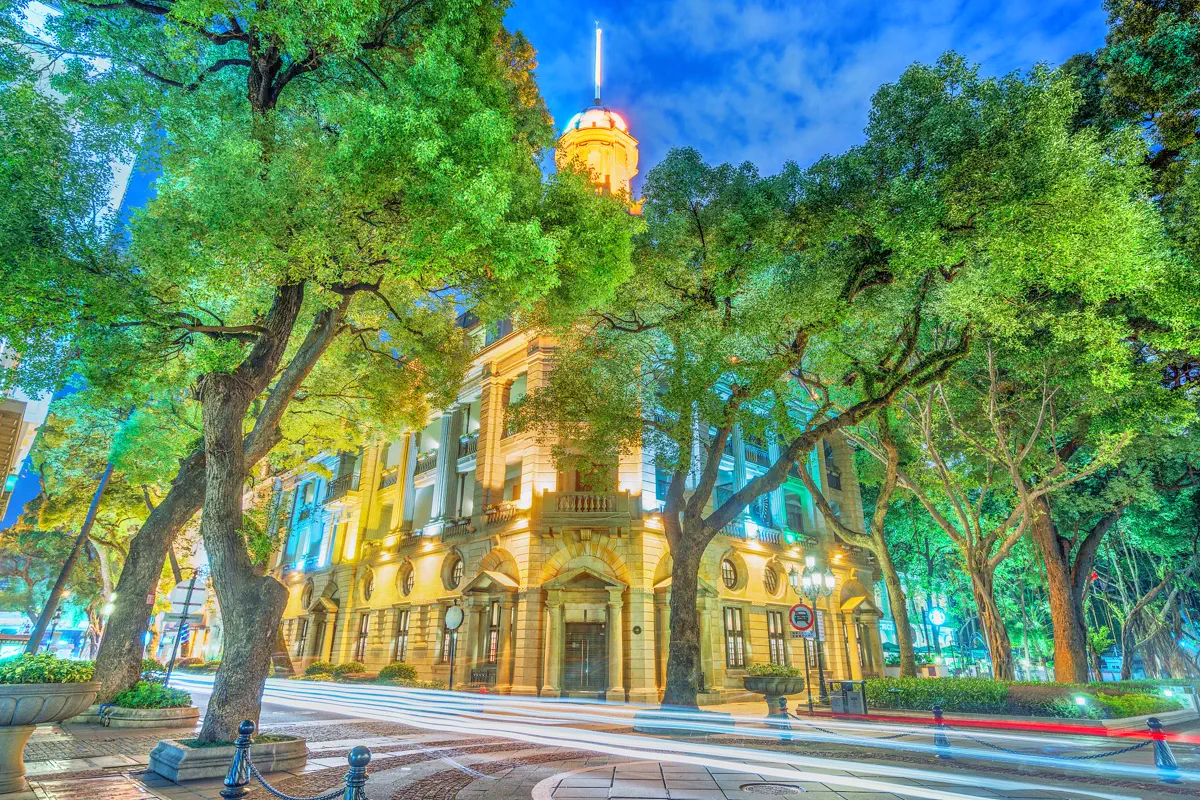
Step across any of the arched stone footbridges spanning the Shaji Canal, and the urban rumble vanishes beneath a towering emerald ceiling of century-old banyans. Behind delicate wrought-iron gates, pastel neoclassical pediments, French Renaissance pilasters, and Gothic spires tell the intricate, turbulent story of Guangzhou's 19th-century foreign concession era. Today, Shamian Island is neither a neglected relic nor a sanitized theme park; it is a protected national historical site where retired Cantonese grandfathers practice tai chi beneath Romanesque porticos, couples take wedding portraits against pastel walls, and travelers enjoy fragrant teas in historic consulates.
Introduction to Shamian Island: Guangzhou's Leafy Enclave
Shamian Island measures approximately 900 meters from east to west and 300 meters from north to south. Despite its modest footprint, the island contains over 150 European-style colonial buildings constructed between the 1860s and the 1930s, 54 of which are individually cataloged as Major National Historical and Cultural Sites protected by China's State Council.
Originally an alluvial sandbar formed by silt deposits from the Pearl River, Shamian was transformed into a fortified diplomatic sanctuary in the aftermath of the Second Opium War (1856–1860). Over the subsequent eight decades, it served as the diplomatic, financial, and logistical hub of Western and Japanese commercial interests in South China. Today, it ranks among the best-preserved collections of Western concession architecture in mainland China, rivaling the Shanghai Bund, Wuhan's Hankou concessions, and Xiamen's Gulangyu Island, while retaining a uniquely relaxed Lingnan subtropical atmosphere.
Geographic Setting and the Formation of an Artificial Island
In historical texts from the Song and Ming dynasties, the area was known as Zhongzhou (Central Sandbar) or Shicui Island. Situated at the strategic water gate of Bai'etan, it was long used as an anchorage for merchant sampans and foreign trading junks trading through the Thirteen Hongs (Thirteen Factories) system located just a few hundred yards to the east.
Following the British and French occupation of Guangzhou in 1859, colonial officials demanded a dedicated foreign quarter that was defensible, close to deep-water shipping lanes, yet insulated from local Chinese residential areas. Rather than building on the crowded mainland, foreign engineers opted to excavate a canal—known as the Shaji Canal (沙基涌)—measuring approximately 30 meters wide and over 1,000 meters long, completely severing the sandbar from the mainland shore along modern-day Liu'ersan Road (June 23rd Road).
Between 1859 and 1861, thousands of Chinese laborers were conscripted to dredge mud from the riverbed to elevate the island's elevation, encasing its perimeter with massive granite seawalls and sluice gates to withstand regular Pearl River tidal surges. Five guarded bridges connected the artificial island to the mainland, each equipped with heavy iron gates that were shut and locked every evening at sunset.
Historic Background: The Dual Concession Era (1859–1945)
In 1861, Britain and France signed formal lease agreements with the Qing imperial court, establishing Shamian as a joint foreign concession. The territory was partitioned along clear imperial lines: the western four-fifths (roughly 240,000 square meters) became the British Concession, while the eastern fifth (roughly 60,000 square meters) formed the French Concession.
The Partition of British and French Zones
The two imperial powers developed their respective quarters with distinct urban layouts and architectural aesthetics:
- The British Concession (West): Characterized by orderly street grids centered along Shamian Main Street (Shamian Dajie), Shamian South Street, and several cross streets numbered One through Five. The British constructed heavy neoclassical banking headquarters (such as HSBC and the Chartered Bank), diplomatic offices, the Anglican Christ Church, extensive tennis lawns, and the exclusive Shameen Club.
- The French Concession (East): Dominated by elegant Parisian-style mansard roofs, ornamental plasterwork, the prominent French Consulate, the Catholic Chapel of Our Lady of Lourdes, and commercial offices of the Banque de l'Indochine and Messageries Maritimes.
By the turn of the 20th century, consulates from more than a dozen nations—including the United States, Germany, Japan, Soviet Russia, Portugal, and the Netherlands—were stationed on Shamian, making it the supreme diplomatic node of southern China.
Anti-Imperialist Resistance and the Shaji Massacre
Shamian was also the flashpoint for pivotal events in modern Chinese history. On June 23, 1925, during the nationwide anti-imperialist movement sparked by the May 30th Incident in Shanghai, over 100,000 workers, students, and Whampoa Military Academy cadets marched along Shaji Road directly across the canal from the concession. Foreign military forces on Shamian opened fire with machine guns across the water, killing over 50 demonstrators and wounding more than 170. Today, a solemn white marble monument—the Shaji Massacre Memorial—stands along the north bank of the canal on Liu'ersan Road, serving as a permanent historical reminder.
Following the end of World War II and the victory against Japanese aggression, the Chinese Nationalist government officially abrogated unequal treaties and formally reclaimed administrative sovereignty over Shamian between 1945 and 1946.
Architectural Highlights on Shamian Island
Walking through Shamian feels like reading an illustrated encyclopedia of Western architectural history translated into the humid subtropics. European architects adapted classical Greek, Roman, Baroque, and Gothic templates to Guangzhou's climate by incorporating deep perimeter verandas, elevated basements for flood mitigation, and wooden louvered shutters for cross-ventilation.
Former HSBC Building (No. 54 Shamian Main Street)
Situated at the intersection of Shamian Main Street and Shamian 4th Street, the former Hongkong and Shanghai Banking Corporation (HSBC) building is the most monumental financial edifice on the island. Completed in 1920, this four-story neoclassical masterpiece features a commanding street-front colonnade supported by six colossal Ionic pillars.
The building's chamfered corner is crowned by a magnificent octagonal copper dome and lantern tower. The ground floor utilizes rusticated granite blocks designed to convey financial permanence, while the upper floors feature deep-set windows and decorative stone balustrades. Inside, original terrazzo tiling, brass stair rails, and high-ceilinged cashier halls remain meticulously preserved.
Former Banque de l'Indochine (No. 20 Shamian South Street)
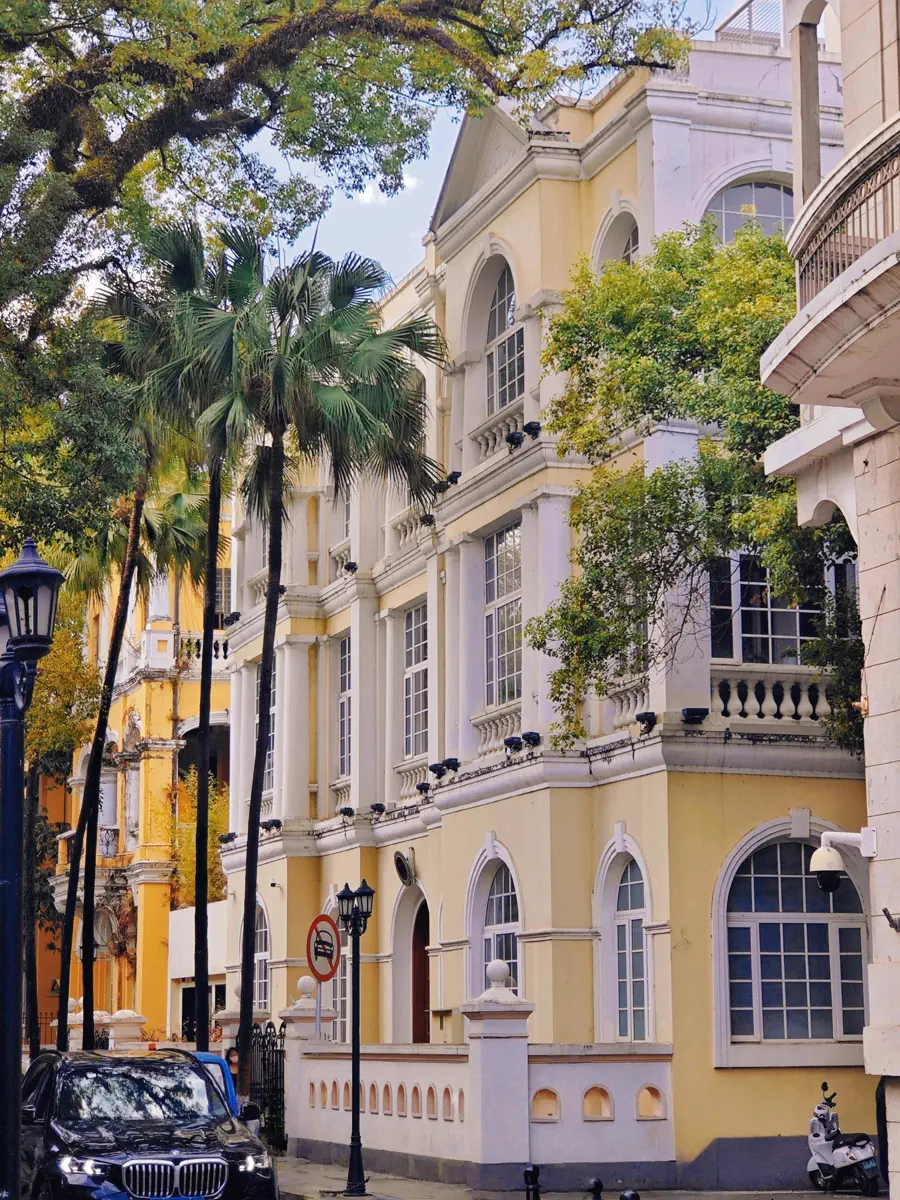
In the former French quarter, the Banque de l'Indochine branch building (constructed in 1899) represents exquisite neo-Baroque styling. Finished in warm ochre plaster, its facade is adorned with ornate stucco cartouches, volutes, and shell motifs framing tall arched windows.
To guard against river moisture and summer heat, the architects raised the main floor upon an arched brick undercroft and installed wraparound wooden louvers that filter intense sunlight while allowing cool river breezes to circulate freely.
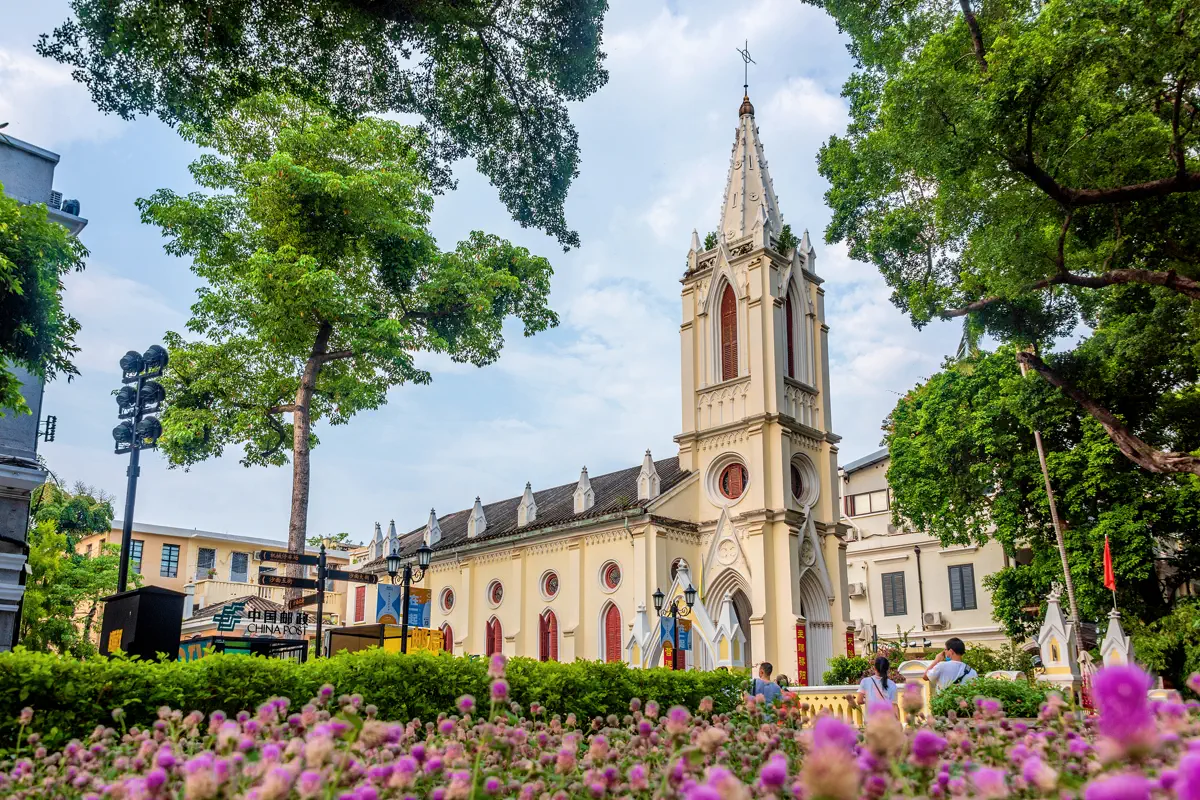
Our Lady of Lourdes Catholic Church (No. 14 Shamian Main Street)
Constructed by the Paris Foreign Missions Society in 1892, this Catholic chapel served the spiritual needs of French diplomats and merchants. The church is a textbook example of Gothic Revival architecture:
- Bell Tower: A slender, soaring pyramidal steeple flanked by stone pinnacles that puncture the leafy tree canopy.
- Portals and Windows: Deeply recessed pointed-arch doorways adorned with multi-tiered archivolts and delicate trefoil tracery.
- Interior: Vaulted rib ceilings and stained-glass lancet windows depicting biblical scenes that cast vivid ruby and cobalt patterns across the stone nave floor during late afternoon services.
Shamian Christ Church (No. 60 Shamian South Street)
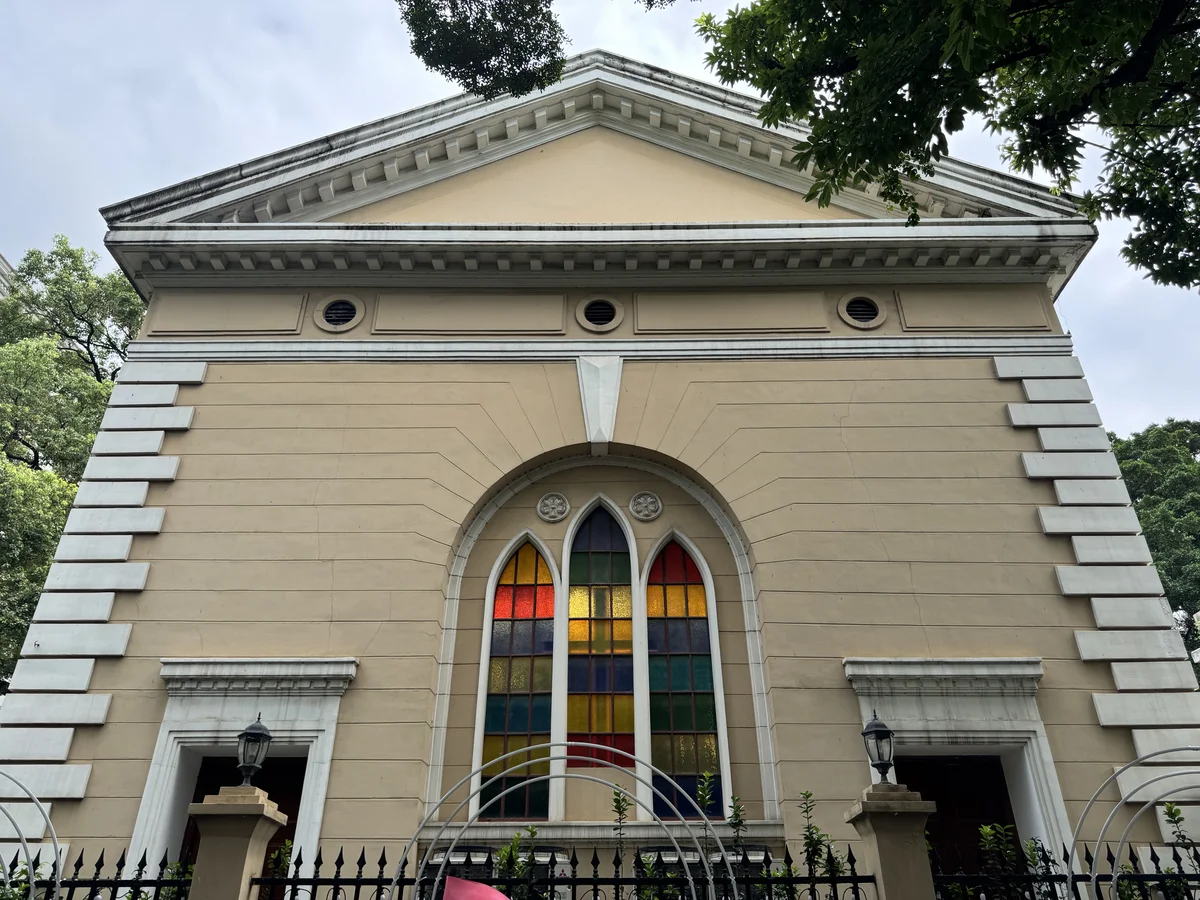
At the western end of Shamian South Street stands Shamian Christ Church, built in 1865 for the British Anglican congregation. In contrast to the vertical thrust of Our Lady of Lourdes, Christ Church adopts a low-slung, pastoral Romanesque Revival idiom.
The building features exposed red-brick masonry, round-arched clerestory windows with limestone voussoirs, and an asymmetrical timber-trussed gable roof clad in terracotta tiles. Surrounded by rolling lawns and ancient camphors, it evokes the serene atmosphere of an English parish church transplanted to southern China.
Customs Club and Staff Quarters (The Red Building)
Located at Nos. 2–6 Shamian Main Street near the eastern bridge, this striking red-brick complex was built in 1907 by the Guangdong Maritime Customs (Canton Customs) as residences for foreign customs inspectors and commissioners. Known colloquially as the "Red Building" (红楼), the structure boasts broad exterior verandas, rounded turret balconies, and red-tiled hip roofs, epitomizing the late-Victorian Queen Anne eclectic style.
The Century-Old Banyan Canopy and Bronze Sculpture Trail
What makes Shamian truly enchanting is how seamlessly its architectural heritage merges with nature. Over 150 ancient banyan trees (Ficus microcarpa and Ficus elastica) line Shamian Main Street and South Street. With massive aerial root networks cascading toward the pavement, their sprawling crowns create a natural temperature drop of 2 to 3°C compared to the asphalt avenues of central Guangzhou.
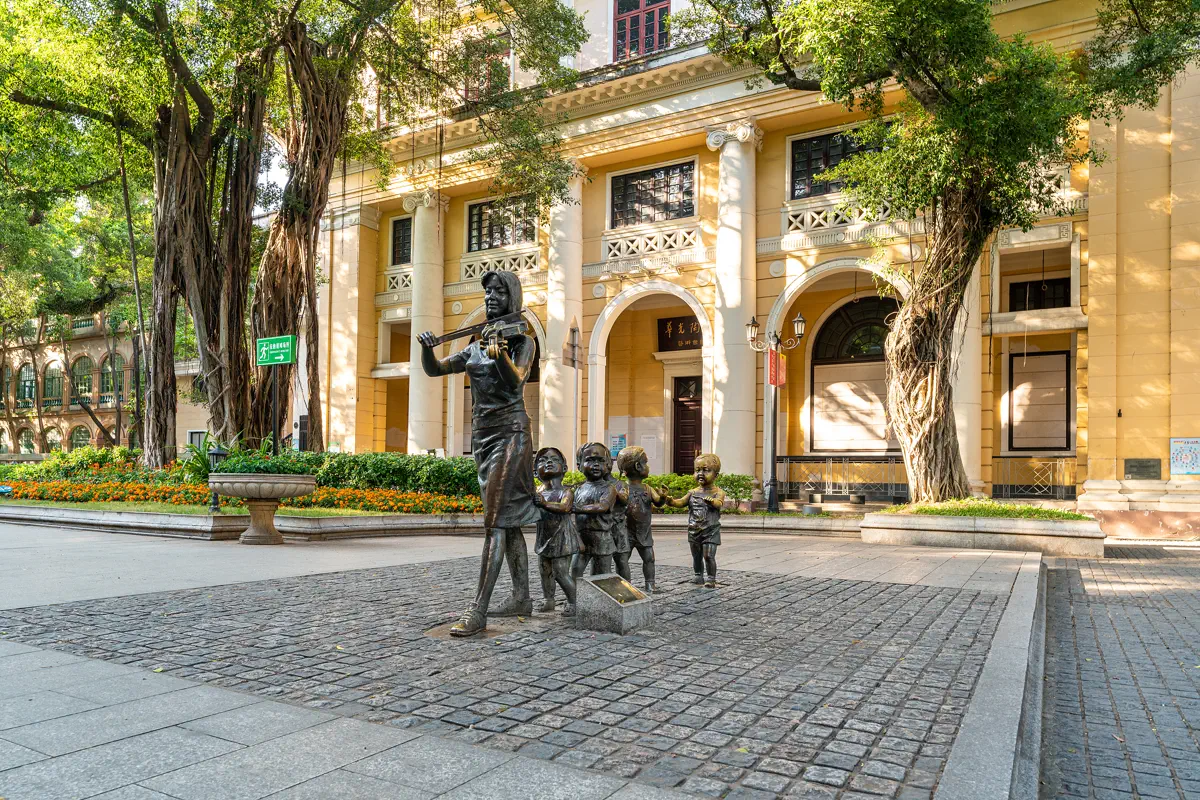
Along the wide pedestrian boulevard dividing Shamian Main Street, visitors will encounter life-sized bronze statues depicting vignettes of late-Qing and early Republic life: a young girl playing the violin under a gas lamp, a photographer peering through an antique bellows camera, a British merchant walking a hound, and Cantonese street vendors selling traditional water chestnuts.
The White Swan Hotel and Bai'etan Riverside Vistas
At No. 1 Shamian South Street, directly fronting the wide expanse of Bai'etan, stands the landmark White Swan Hotel (白天鹅宾馆). Opened in 1983 through a pioneering investment led by Hong Kong patriotic entrepreneur Henry Fok Ying-tung, the White Swan was mainland China's very first five-star hotel developed through joint Sino-foreign partnership, and the first designed and constructed entirely by Chinese architects.
The hotel is famed for its breathtaking central atrium, dominated by a towering indoor rockery and multi-tiered waterfall known as "Waters of Hometown" (故乡水). Above the cascading falls perches the gilded Tingyue Pavilion, an enduring cultural touchstone for overseas Chinese returning to their ancestral homeland.
Even if you are not staying as an overnight guest, visiting the White Swan's second-floor tea house, Yu Tang Chun Nuan (玉堂春暖), is an essential Guangzhou culinary pilgrimage. Arrive early or reserve well in advance to enjoy Michelin-starred Cantonese dim sum—including signature crystal shrimp dumplings (har gow), baked walnut pastries, and roasted squab—while watching cargo barges and passenger ferries glide across the golden waters of the Pearl River.
Self-Guided Walking Tour: Recommended Routes and Timing
Because Shamian is strictly closed to motor vehicle traffic except for local service carts, it is one of the most walker-friendly zones in all of southern China. Allow approximately 2 to 3 hours for a leisurely visit.
The Classic 2-Hour Heritage Stroll
Follow this curated route to experience the island's best highlights without backtracking:
- Start at West Bridge (Huangsha Metro Station, Exit F): Cross the covered bridge over Shaji Canal into the western gateway of Shamian.
- Shamian Christ Church: Head south along Shamian 1st Street to inspect the red-brick facade and tranquil gardens of Christ Church (No. 60 Shamian South Street).
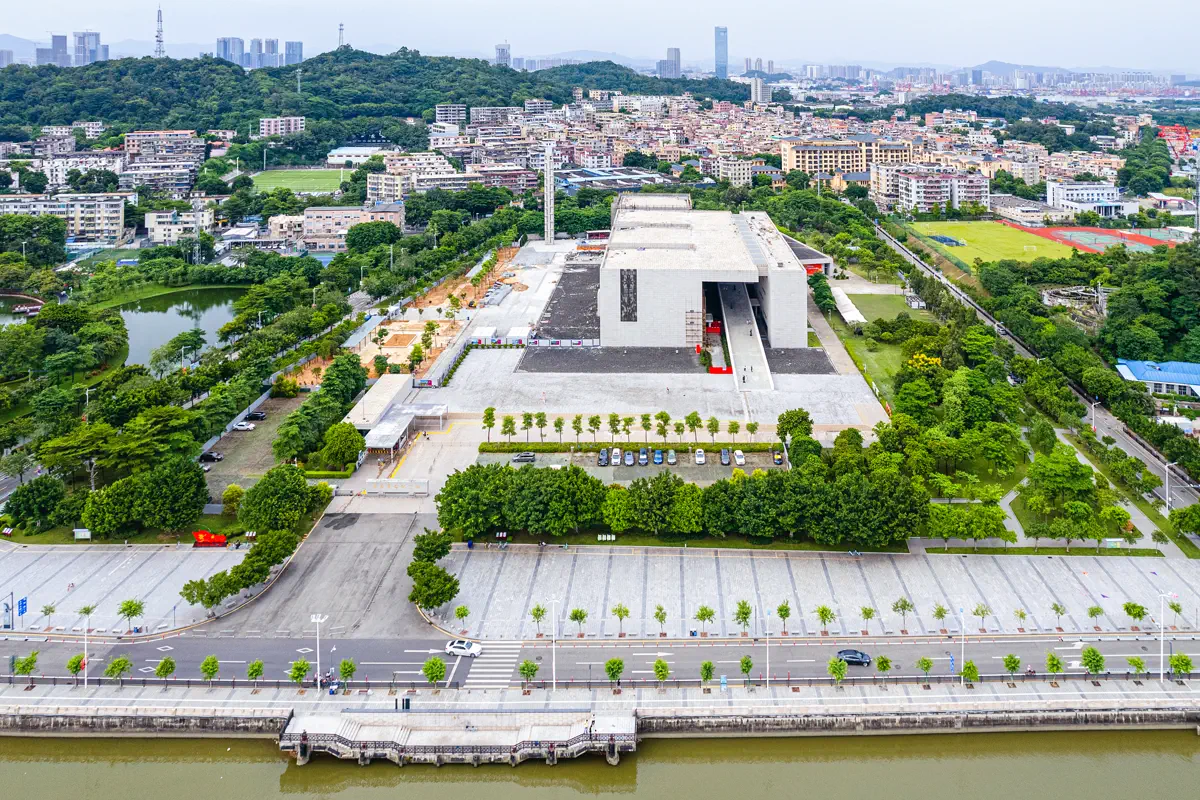
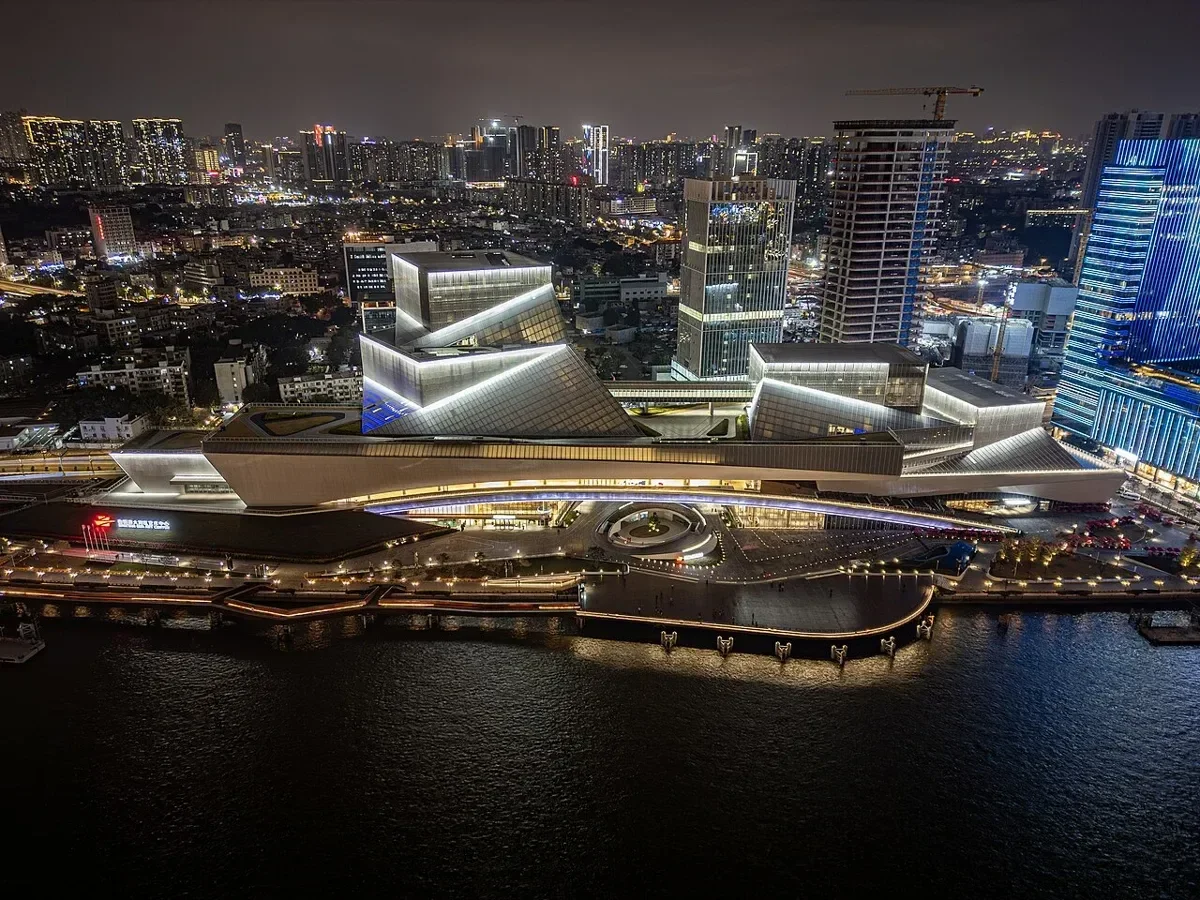
- Shamian South Street & Riverside Promenade: Walk eastward along the riverside embankment. Take in panoramic views across Bai'etan toward the newly opened Baietan Greater Bay Area Art Center on the Fangcun bank, and inspect the neoclassical facades of former trading companies.
- Former HSBC Building: Turn north at Shamian 4th Street to admire the colossal Ionic portico and domed corner tower of the HSBC building.
- Shamian Main Street Boulevard: Stroll eastward along the central banyan-shaded garden mall, photographing the bronze sculptures and stopping at Our Lady of Lourdes Church (No. 14).
- The Red Building & Banque de l'Indochine: Explore the eastern sector's French Renaissance mansions and the Customs Staff Quarters.
- White Swan Hotel: Finish your walking loop at the White Swan Hotel for afternoon tea or dim sum before exiting across the East Bridge toward Cultural Park.
Best Photo Spots and Golden Hour Timing
The optimal time to visit Shamian Island is between 3:00 PM and 6:30 PM. During these golden afternoon hours, warm sunlight filters through the dense banyan foliage, creating soft dappled highlights across ochre stucco and gray stone. As dusk falls, warm architectural uplighting illuminates the cupolas and colonnades, while the riverbanks offer front-row views of the sunset over Bai'etan before boarding an evening Pearl River Night Cruise.
Practical Information: Metro Access, Opening Hours, and Nearby Sights
| Detail | Information |
|---|---|
| Admission Fee | Free (Island public spaces and gardens are open 24/7) |
| Suggested Duration | 2 to 3 hours |
| Nearest Metro Stations | Huangsha Station (Line 1 & 6, Exit F) / Cultural Park Station (Line 6 & 8, Exit A or E) |
| Best Season | October through April (pleasantly cool and dry) |
How to Get to Shamian Island by Metro
Shamian Island is exceptionally accessible via Guangzhou Metro:
- Via Huangsha Station (Line 1 & Line 6): Take Exit F. Ascend the outdoor pedestrian footbridge directly over Liu'ersan Road and cross the West Bridge onto Shamian 1st Street. Walking time is approximately 3 minutes.
- Via Cultural Park Station (Line 6 & Line 8): Take Exit A or E. Walk south along Xiti 2nd Road for about 300 meters and cross the East Bridge into the French concession sector. Walking time is approximately 5 minutes.
Nearby Attractions in Liwan District
Because Shamian is situated in the historic heart of Xiguan (Western Suburbs), it pairs seamlessly with other top cultural destinations within walking or short transit distance:
- Yongqing Fang (永庆坊): Located just 800 meters north along Enning Road, this revitalized historic neighborhood features Xiguan mansion architecture, water-town canals, the Bruce Lee Ancestral Residence, and the Cantonese Opera Art Museum.
- Chen Clan Ancestral Hall (陈家祠): Just two metro stops away on Line 1, this 1894 ancestral complex showcases masterclasses in Guangdong roof pottery, woodcarving, and brick sculptures.
- Sacred Heart Cathedral (石室圣心大教堂): Located 2 km east along the riverbank, this massive 1888 French granite cathedral offers a striking Gothic counterpart to Shamian's churches.
- Qingping Chinese Medicine Market: Located immediately north across the canal on Liu'ersan Road, this is one of Asia's largest wholesale markets for traditional herbs, dried seafood, and botanicals.
Frequently Asked Questions About Shamian Island
Is Shamian Island completely free to visit?
Yes. Access to Shamian Island, its tree-lined public parks, central promenades, and riverfront boardwalks is completely free and unrestricted 24 hours a day. While government offices and private residences located inside historical buildings are closed to the public, many colonial structures now house public cafes, art galleries, restaurants, and hotels that welcome visitors inside.
Can I go inside the churches on Shamian Island?
Our Lady of Lourdes Catholic Church and Shamian Christ Church are active places of worship. They generally open their doors during scheduled weekend services (Saturday evening and Sunday morning/afternoon) and for specific Catholic/Protestant holiday observances. Modest dress is requested when entering church interiors.
Is Shamian Island suitable for travelers with strollers or wheelchairs?
Yes. Shamian Island is flat and completely pedestrianized. Curb cuts and ramps are installed along all main footbridges, central promenades, and park gardens, making it one of the most accessible sightseeing destinations in Guangzhou.
How far is Shamian Island from Guangzhou Baiyun International Airport?
Shamian Island is approximately 35 kilometers south of Guangzhou Baiyun International Airport (CAN). By metro, take Line 3 from Airport South or North Station to Jiahewanggang, transfer to Line 2 to Gongyuanqian, and transfer to Line 1 to Huangsha Station (total journey time roughly 65–75 minutes). By taxi or ride-hailing (DiDi), the trip takes 45 to 60 minutes depending on expressway traffic.