Guangzhou Attractions 9 min read
Guangzhou Beijing Road: Millennium Relics, Dafo Temple & Food Guide
Explore Guangzhou Beijing Road Pedestrian Street: 11 layers of ancient road relics beneath glass pavement, Dafo Temple illuminations, Qilou arcades, food, and metro guide.
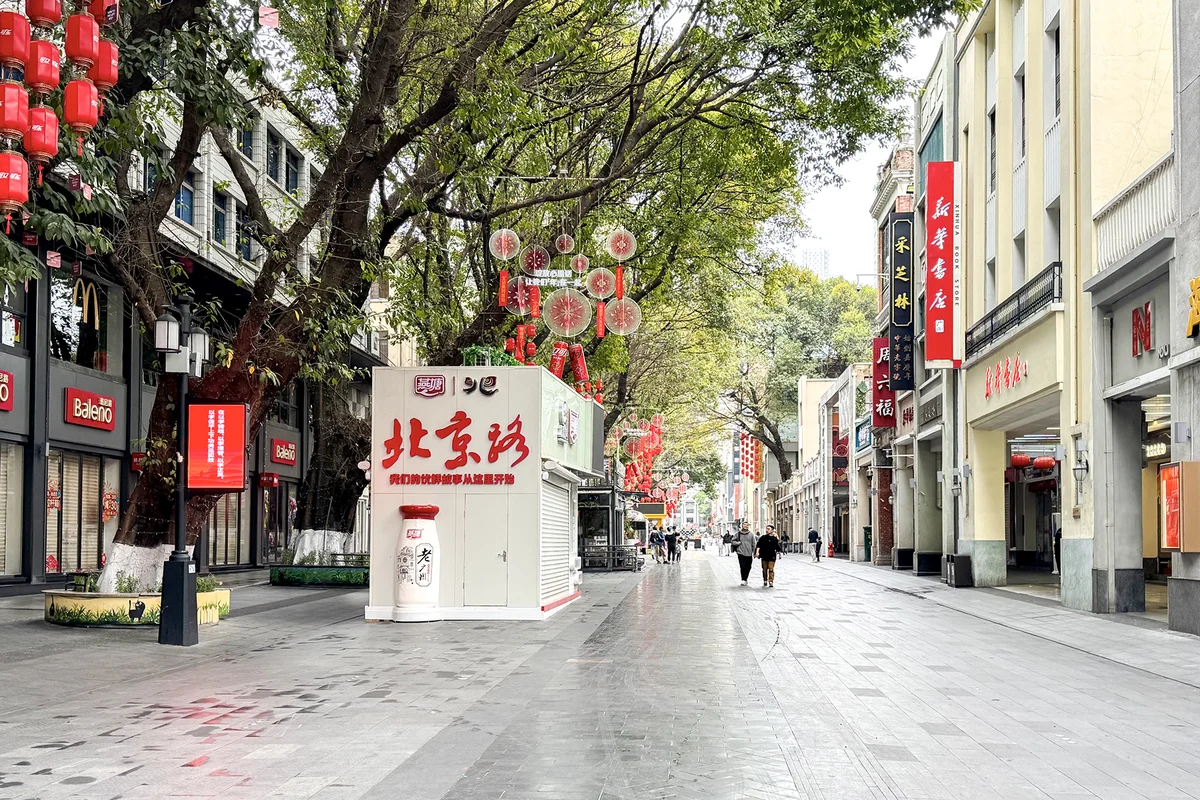
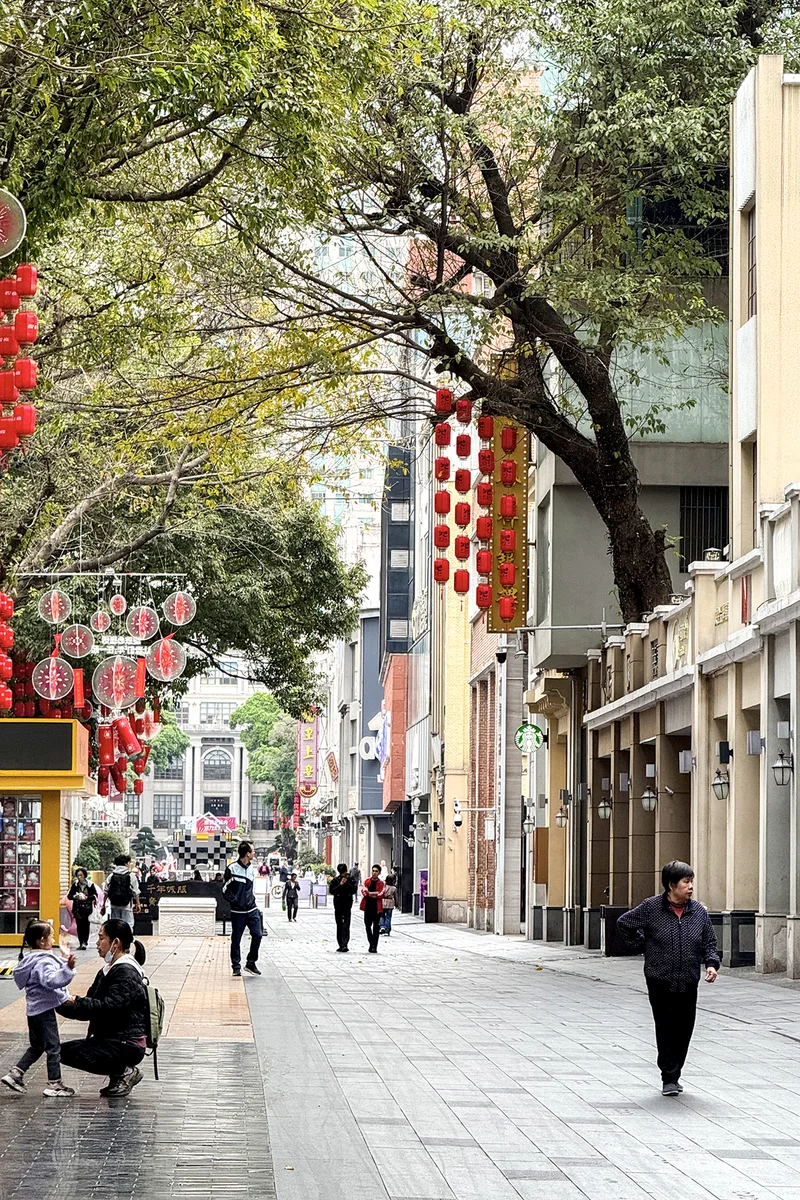
In the beating geographic center of Guangzhou's Yuexiu District stretches Beijing Road (北京路, Beijing Lu), an energetic 1,400-meter pedestrian avenue flanked by covered Republican-era Qilou arcades, glowing vintage neon signs, and bustling modern retail flagships. Yet beneath the footsteps of millions of shoppers lies an archaeological wonder unmatched by any other Asian metropolis: twenty-two centuries of unbroken urban governance and commerce on the exact same plot of land.
While world capitals like Rome, London, or Beijing have shifted their administrative and commercial epicenters over the millennia, Guangzhou's urban axis has remained anchored here since General Ren Xiao founded the ancient garrison of Panyu in 214 BCE. Today, visitors walking down Beijing Road literally stroll across open-air glass display corridors revealing eleven superimposed layers of historic roadways, explore the towering illuminated timber eaves of Dafo Temple, taste time-honored Cantonese delicacies, and walk directly to the historic piers of the Pearl River.
Introduction: The Unshifted 2,200-Year Heart of Guangzhou
Beijing Road runs directly south from Guangwei Road to Taikang Road. Historically known as Chengxuan Street during the Ming and Qing dynasties and nicknamed Shuangmendi ("Under the Double Gates") after the dual portals of the medieval Gongbei Tower, it was rechristened Yonghan Road in the early 20th century before adopting its current name in 1966.
In 2002, the municipal government pedestrianized the northern and central sections of Beijing Road. Rather than transforming it into an ordinary commercial mall, urban planners turned the boulevard into an open-air cultural museum. Today, Beijing Road seamlessly integrates five major national historical monuments within a 500-meter radius, including the Nanyue Kingdom Palace site, the ancient Western Han wooden water sluice, the Dafo Temple, and the Guangzhou City God Temple.
Thousand-Year Ancient Road: Eleven Layers of History Beneath Glass
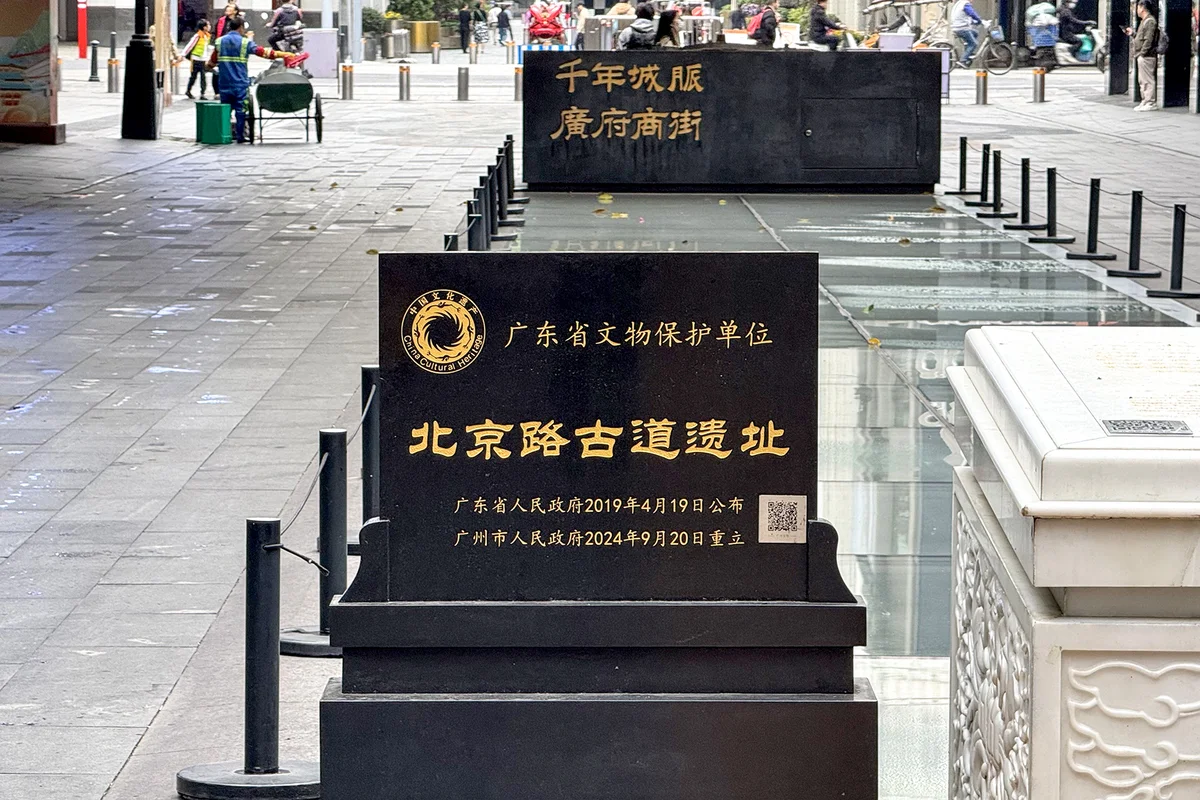
The visual signature of Beijing Road is the Thousand-Year Ancient Road Relics (千年古道遗址), located right in the center of the pedestrian promenade.
The Archaeological Discovery of 2002
During municipal pipeline renovations in July 2002, construction workers struck ancient stone paving blocks approximately 0.5 meters below modern asphalt. A rescue excavation led by the Guangzhou Institute of Cultural Relics and Archaeology soon uncovered one of China's most significant urban street stratigraphies.
Reaching downward nearly 3 meters, archaeologists identified eleven distinct historical road surfaces stacked vertically one on top of the other:
- Republican Era (1912–1949): Paved granite slab curbs and modern macadam foundations.
- Qing Dynasty (1644–1912): Broad granite flagstone blocks with drainage conduits.
- Ming Dynasty (1368–1644): Red sandstone pavers and foundational footings of the Shuangmendi Gate Tower.
- Song and Yuan Dynasties (960–1368): Fired paving bricks laid in intricate herringbone patterns, showing deep wheel ruts worn by wooden handcarts and horse-drawn carriages over centuries.
- Southern Han and Tang Dynasties (618–960): Compacted crushed-tile road beds and wooden foundation pilings anchoring the medieval thoroughfare.
Instead of reburying the site, city planners covered the excavated trench with heavy laminated tempered glass fitted with internal climate control and LED lighting. Visitors can walk directly above the ancient roadbeds, looking down through centuries of urban footprints beneath their feet.
The Yuan Dynasty Clepsydra and Gongbei Tower Memory
Just north of the glass pavilion stands a full-scale bronze replica of China's largest and most complete ancient water clock: the Yuan Dynasty Clepsydra (元代铜壶滴漏). Cast in 1316 during the reign of Emperor Renzong of Yuan by Cantonese metallurgists, the original clepsydra sat atop Gongbei Tower for over five centuries, marking the official civil time for Guangzhou's citizens by ringing bells and drums at regular intervals.
The apparatus consists of four stepped bronze vessels—the Sun Vessel, Moon Vessel, Level Vessel, and Water Receiving Vessel—measuring water flow via a floating wooden index. While the original national treasure is preserved in the National Museum of China in Beijing, this gleaming replica anchors the civic memory of Guangzhou's timekeeping heritage.
Dafo Temple: Ancient Zen Sanctuary and Spectacular Night Illumination
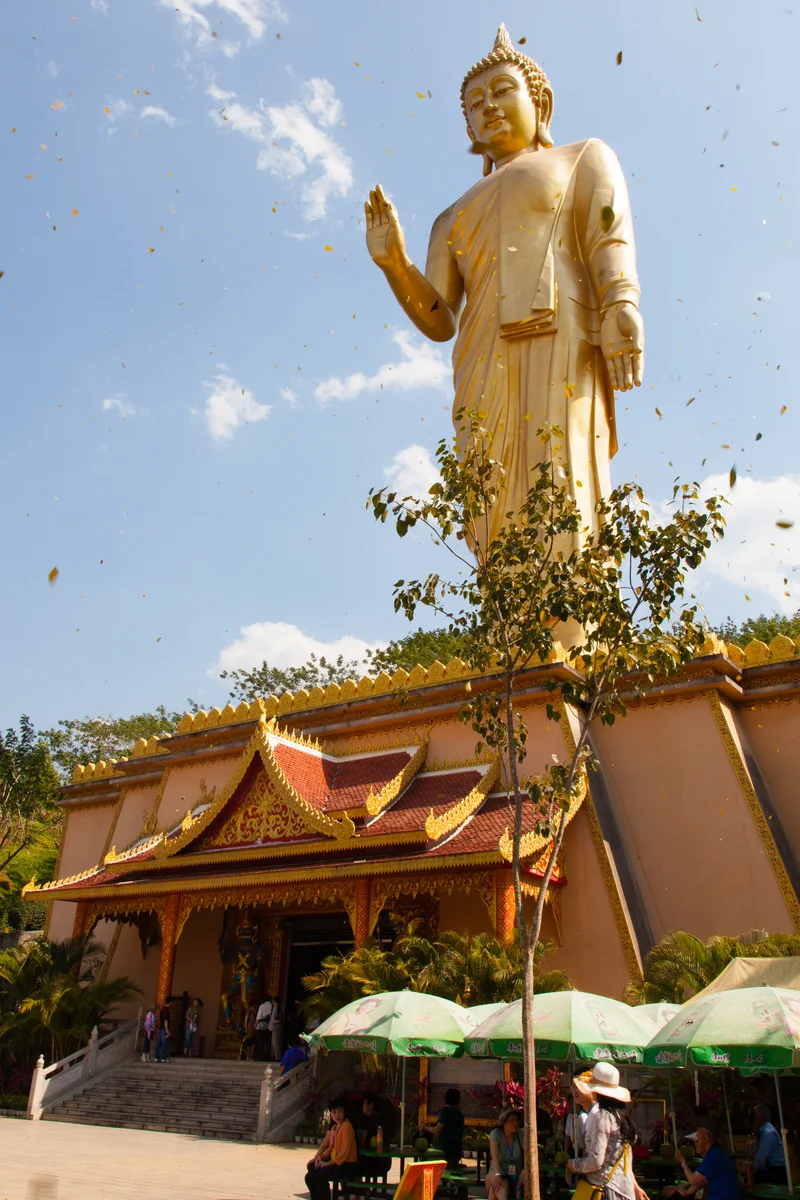
Tucked immediately behind modern shopping malls at No. 21 Huixin Middle Street, just steps from the bustling pedestrian thoroughfare, lies Dafo Temple (大佛寺, Great Buddha Monastery). Founded over 1,000 years ago during the Southern Han Dynasty (917–971) as Xincang Temple, it is one of Guangzhou's "Five Major Buddhist Monasteries."
History of the Great Buddha Monastery Since the Southern Han
After being reduced to ashes during the Ming-Qing dynastic transition, the temple was lavishly resurrected in 1663 during the second year of Emperor Kangxi's reign by Shang Kexi, the Prince of Pingnan. Shang Kexi poured his personal fortune into creating an imposing monastery modeled after classical northern Chinese palace halls.
The Main Mahavira Hall and Three Ten-Ton Bronze Buddhas
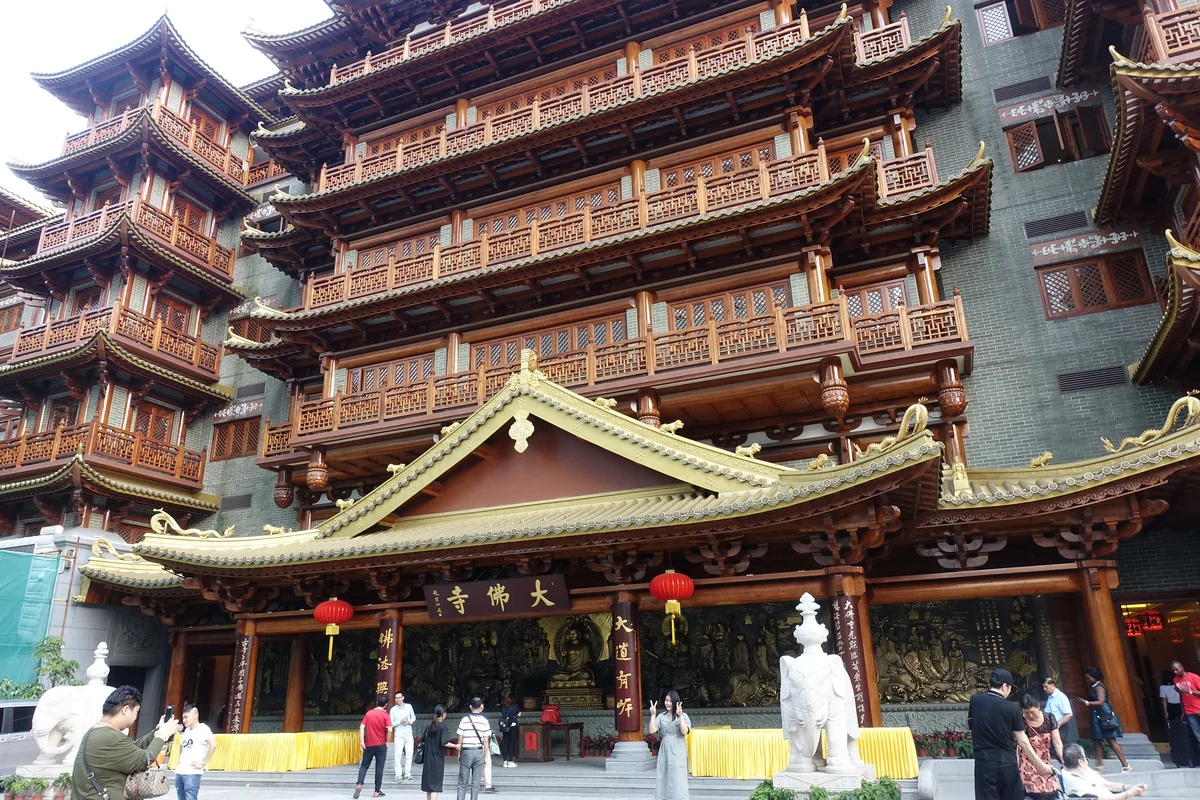
The architectural centerpiece of the complex is the grand Main Mahavira Hall (大雄宝殿). Measuring seven bays wide and five bays deep with a double-eaved hip-and-gable roof, the hall was constructed using colossal ironwood timber pillars imported from Southeast Asia.
Enshrined within are three magnificent bronze Buddha statues representing the Trikaya (Three Bodies of the Buddha). Each figure stands over 6 meters tall and weighs upwards of 10 tons, ranking among the heaviest historical bronze castings in South China.
The Multi-Tiered Timber Pavilions at Golden Hour
In recent years, the temple completed a masterwork of traditional carpentry along its northern flank: the towering Hongfa Pavilion and Wanfo Pavilion. Rising five soaring tiers with cascading bracket systems (dougong) and intricate wooden fretwork screens, these timber towers have become a viral sensation among travelers.
Every evening precisely at 6:30 PM, warm amber LED lighting traces every upturned flying eave, carved balustrade, and timber archway. When illuminated against the twilight sky, the complex evokes the spellbinding visual splendor of the bathhouse in Hayao Miyazaki's animated classic Spirited Away. Entry to the temple grounds is completely free.
Qilou Architecture and Historic Surrounds
Beijing Road's cultural tapestry extends well beyond its main promenade into surrounding historic alleyways:
Guangzhou City God Temple and Chenghuang Culture
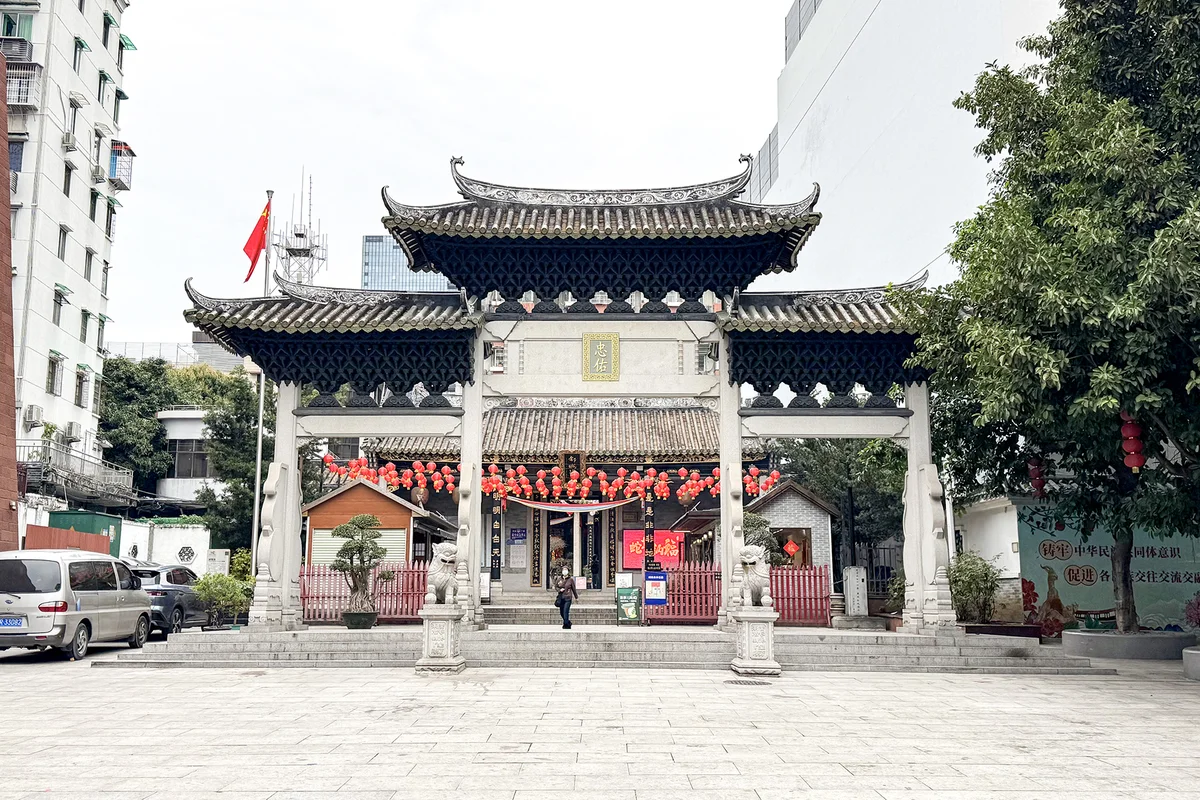
Located on Zhongyou Lane near the northern end of Beijing Road, the Guangzhou City God Temple (广州城隍庙) dates back to 1370 during the Ming Dynasty. Historically the highest-ranking prefecture City God temple in Guangdong Province, the temple features majestic Lingnan ceramic roof ridges, stone lion guardians, and gilded shrine canopies dedicated to the guardian deities of the city. Each spring during the Lantern Festival, the temple grounds host the lively Guangfu Temple Fair.
Republican Qilou Arcades and Modern Pedestrian Promenade
Stretching down both flanks of Beijing Road are two- and three-story Qilou (shophouse) arcades built between the 1920s and 1930s. The sheltered walkways protect pedestrians from subtropical monsoons and blazing heat, while the upper facades display an eclectic blend of Roman arches, Baroque plaster pediments, and traditional Cantonese stained-glass transoms.
Time-Honored Cantonese Dining Around Beijing Road
Beijing Road and its intersecting cross streets—especially Huifu East Road and Wenming Road—form one of Guangzhou's most concentrated gourmet street food districts:
| Establishment | Must-Try Specialties | Location & Details |
|---|---|---|
| Tai Ping Koon (太平馆西餐厅) | Signature Roasted Pigeon, Prime Chateaubriand Steak, Baked Alaska | No. 342 Beijing Road. Founded in 1885; China's first Western restaurant, frequented by Premier Zhou Enlai. |
| Yinji Rice Noodle Rolls (银记肠粉) | Fresh Beef Steamed Rice Rolls, Sampan Congee (Tingzai Zhou) | Huifu East Road branch. Michelin Bib Gourmand recipient for silky hand-steamed rolls. |
| Qiaomei Wonton Noodles (巧美面家) | Five-Treasure Wonton Noodles (fresh shrimp, crab roe, abalone), bamboo-pressed duck egg noodles | No. 125 Donghua West Road / Huifu East branch. Historic bamboo-pressed egg noodles in rich dried flounder broth. |
| Baji Braised Beef Offal (八珍煎饺 / 牛杂) | Golden pan-fried pork dumplings, slow-simmered radish and beef brisket pots | Beijing Road pedestrian lane. Legendary local street stall open since 1956. |
| Bao Hua Sweet Desserts | Double-skin steamed milk curd, ginger milk pudding, mango pomelo sago | Wenming Road dessert strip. Traditional southern water buffalo milk desserts. |
Recommended Walking Tour: Day to Night
To experience Beijing Road at its magical best, begin in the mid-afternoon to tour the ancient excavations, transition into twilight illuminations at Dafo Temple, and conclude with dinner and a riverside night stroll.
The 3-Hour Heritage and Nightscape Circuit
- 3:00 PM – Nanyue King Palace & City God Temple: Start near Metro Line 1 Peasant Movement Institute Station, visiting the Nanyue Palace Museum and City God Temple.
- 4:15 PM – Ancient Road Relics & Clepsydra: Walk south into Beijing Road, inspecting the 11 road strata under the glass pavement and photographing the Yuan Dynasty water clock.
- 5:15 PM – Culinary Exploration on Huifu East Road: Sample crispy pan-fried dumplings and wonton noodles along the food strip.
- 6:15 PM – Dafo Temple Illumination: Step inside Dafo Temple courtyard to witness the spectacular 6:30 PM lighting ceremony.
- 7:30 PM – Stroll to Tianzi Pier: Walk south along Beijing Road and Beijing South Road for 600 meters to reach the Pearl River embankment.
Connecting to Tianzi Pier and the Pearl River
Beijing Road terminates just two blocks north of Tianzi Pier (天字码头, "Heaven Pier"). Constructed in 1729 during the reign of Emperor Yongzheng, Tianzi was historically Canton's supreme official ferry slip, welcoming imperial magistrates, Western diplomats, and Imperial Commissioner Lin Zexu. Today, Tianzi Pier serves as the primary embarkation dock for the celebrated Pearl River Night Cruise, offering departures every 15 minutes that sail past the neon skyline of Canton Tower and Haixin Bridge.
Practical Travel Information: Metro, Hours, and Tips
| Item | Travel Information |
|---|---|
| Admission Fee | Free (Street, Ancient Road glass pavement, Dafo Temple, and City God Temple) |
| Operating Hours | Pedestrian street: Open 24/7 (Shops typically operate 10:00 AM – 10:00 PM) Dafo Temple: 8:00 AM – 8:30 PM daily (Evening lights on ~6:30 PM – 9:30 PM) |
| Nearest Metro Stations | Beijing Road Station (Line 6, Exit B, 3-min walk) Gongyuanqian Station (Line 1 & Line 2, Exit E, 5-min walk) |
| Suggested Duration | 2.5 to 4 hours |
| Nearby Cultural Sights | Yuexiu Park (1.5 km north), Sacred Heart Cathedral (1.2 km southwest), Chen Clan Ancestral Hall (2.5 km west via Line 1) |
Frequently Asked Questions About Beijing Road
What time does Dafo Temple turn on its lights?
Dafo Temple activates its external building illuminations every evening at approximately 6:30 PM (around 7:00 PM during midsummer and 6:15 PM in winter), turning them off at 9:30 PM. The best photography window is between 6:30 PM and 7:15 PM during astronomical twilight.
Can I walk on top of the Thousand-Year Ancient Road glass pavement?
Yes. The glass covers are constructed from reinforced laminated tempered structural glass designed specifically for heavy pedestrian foot traffic. It is completely safe to walk directly over the glass and view the layered brick roads beneath.
Is Beijing Road connected to other famous shopping areas in Guangzhou?
Yes. Taking Metro Line 1 westward for two stops leads to Shangxiajiu Pedestrian Street and Yongqing Fang in Liwan District, while heading east on Line 1 or Line 6 connects directly to the red-brick heritage district of Dongshankou.
Is street food safe to eat on Huifu East Road?
Yes. All food vendors and eateries along Huifu East Road are licensed brick-and-mortar restaurants inspected regularly by municipal food safety authorities. High patron turnover guarantees fresh ingredients, especially for steamed dumplings, noodle dishes, and Cantonese broths.