Guangzhou Attractions 9 min read
Guangzhou Yuexiu Park Guide: Five Rams, Ming Wall & Zhenhai Tower
Complete travel guide to Yuexiu Park in Guangzhou: Five Rams Sculpture, Ming Dynasty City Wall, Zhenhai Tower (Guangzhou Museum), Sun Yat-sen Monument, maps, and metro tips.
Rising immediately north of Guangzhou's Old Town, Yuexiu Park (越秀公园) covers 860,000 square meters (approximately 212 acres) of forested hills, shimmering lakes, and ancient defensive fortifications. Comprising the rolling ridges of Yuexiu Mountain—historically referred to as Guanyin Hill or Yuexiu Hill—this lush municipal sanctuary is the largest public green space in central Guangzhou.
More than just an urban park, Yuexiu Mountain serves as the historical anchor of Guangzhou's 2,200-year urban journey. Here, along winding cobblestone ridges shaded by ancient banyans and eucalyptus groves, visitors can touch the city's only surviving Ming Dynasty city ramparts, climb the imposing five-story red watchtower of Zhenhai Tower, gaze upon the revered Five Rams Sculpture, and retrace China's Republican revolution along the monumental Sun Yat-sen memorial axis.
Introduction to Yuexiu Park: Guangzhou's Historic Green Heart
Positioned along the traditional north-south urban axis of Guangzhou, Yuexiu Park spans seven undulating hills—including Yuejing Hill, Guihua Hill, and Muke Hill—and three scenic artificial lakes: Dongxiu, Nanxiu, and Beixiu. Forest canopy covers over 80 percent of the park grounds, creating a natural microclimate that remains noticeably cooler than the surrounding avenues of Yuexiu District.
Formal development of the park began in 1927 following the initiative of Dr. Sun Yat-sen, the founding father of modern China, who advocated preserving the wooded ridges as a public people's park. Today, the park offers admission-free access to all public trails, manicured gardens, and historical promenades, welcoming thousands of daily joggers, tai chi masters, amateur Cantonese opera troupes, and international travelers.
Geological and Historical Origins of Yuexiu Mountain
From a geomantic and strategic perspective, Yuexiu Mountain has anchored Guangzhou since the Qin Dynasty. In 214 BCE, General Ren Xiao constructed the fortified outpost of Panyu (ancient Guangzhou) south of the mountain, relying on the high peaks of Yuexiu as a natural northern rampart shielding the fertile Pearl River estuary.
During the Western Han Dynasty, King Zhao Tuo of the Nanyue Kingdom built royal pleasure villas and observation pavilions across the slopes, an imperial presence evidenced by the lavish Western Han Nanyue King's Tomb excavated directly across Jiefang North Road from the park's west gate. Over successive centuries, Chinese literati celebrated Yuexiu Mountain in poetry, designating its scenic vistas among the renowned Eight Sights of Guangzhou (羊城八景) throughout the Song, Yuan, Ming, and Qing dynasties.
Must-See Historical Landmarks in Yuexiu Park
Yuexiu Park acts as an outdoor museum, with four premier cultural monuments spanning the 14th to the 20th century:
The Five Rams Sculpture: Symbol of the City of Rams
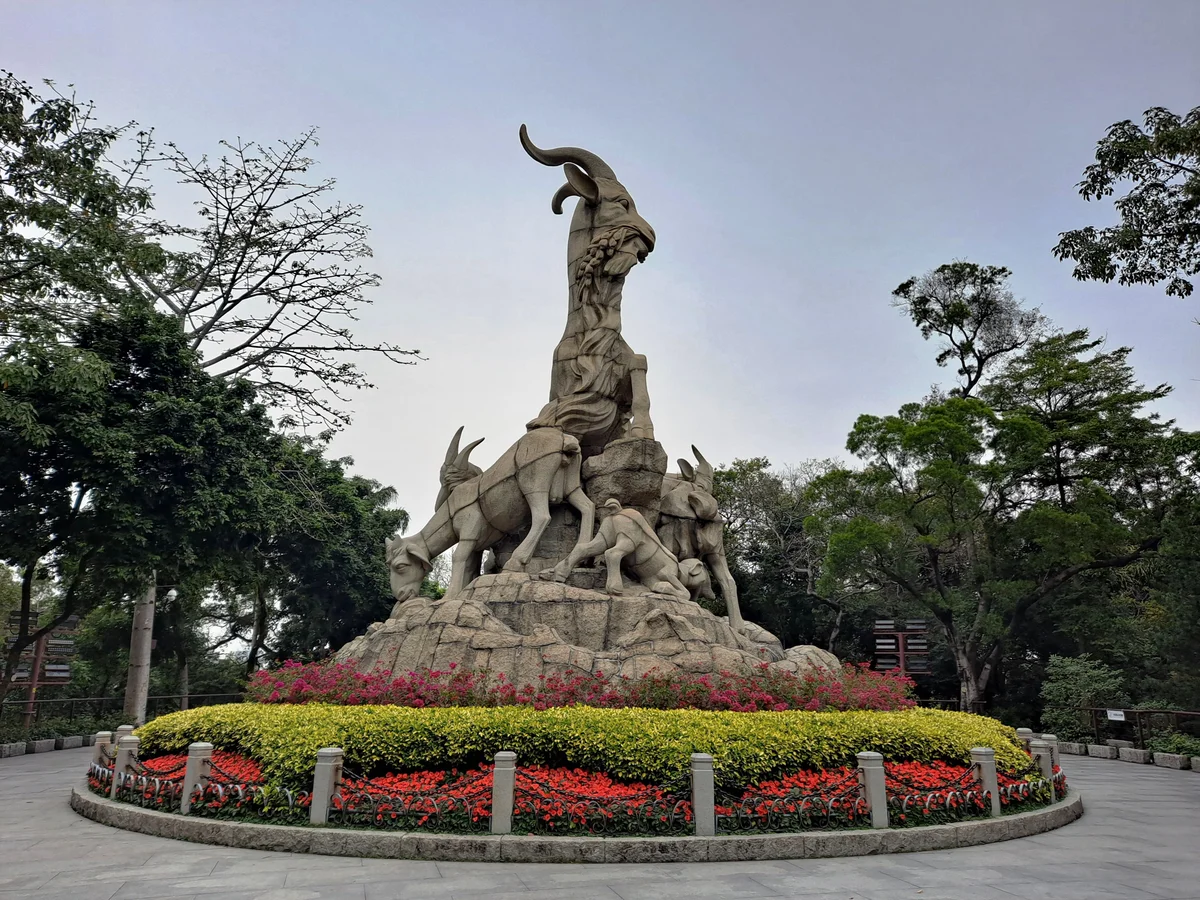
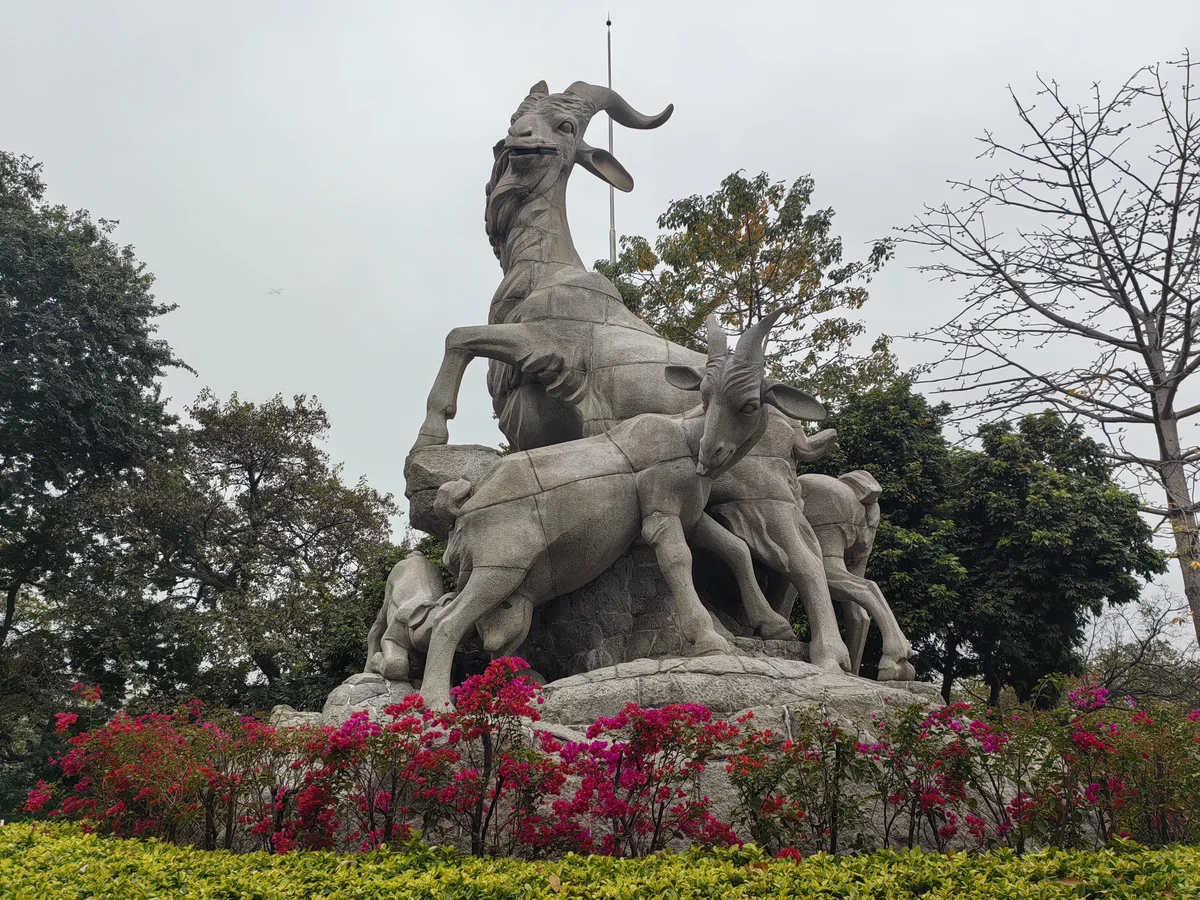
Perched on the summit of Muke Hill stands the Five Rams Sculpture (五羊石像), the universally recognized crest of Guangzhou. Completed in 1959 by master sculptors Yin Jichang, Chen Benzong, and Kong Fanwei, the statue rises 11 meters high and was carved from over 130 interlocking blocks of gray granite.
The monument brings to life Guangzhou's founding legend, first recorded in the 4th-century chronicles of the Jin Dynasty. Legend recounts that during a severe famine in the Zhou Dynasty, five celestial immortals in multi-colored robes descended on five rams of different hues, landing at Chuting (early Guangzhou). The immortals presented ears of golden grain to the starving inhabitants, blessing the region with perpetual abundance before vanishing into the clouds. The celestial rams transformed into stone on the hill, giving Guangzhou its enduring poetic monikers: the City of Rams (羊城, Yangcheng) and the City of Ears (穗城, Suicheng).
Zhenhai Tower (Guangzhou Museum)
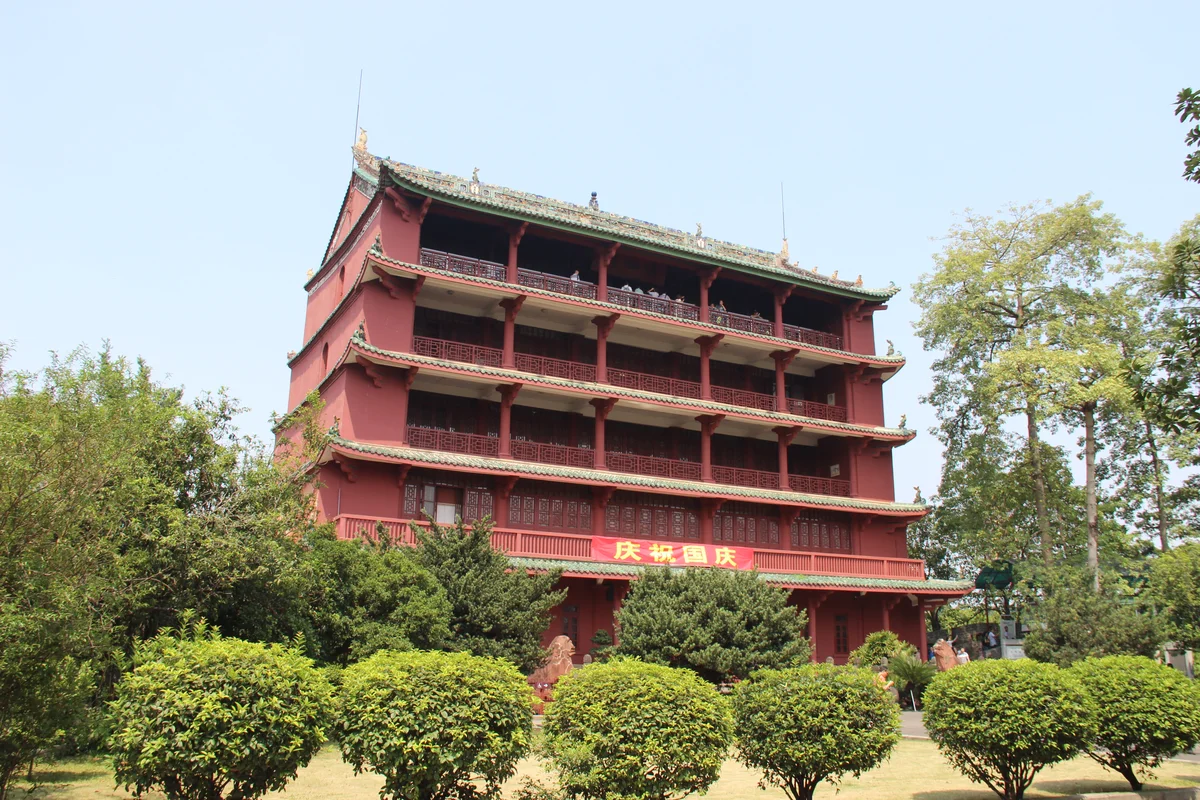
Crowning the highest point of Yuexiu Mountain stands Zhenhai Tower (镇海楼, "Tower Guarding the Sea"). Constructed in 1380 during the 13th year of Ming Emperor Hongwu's reign by Marquis Zhu Liangzu, this majestic structure measures 28 meters tall, 31 meters wide, and 16 meters deep. Known colloquially among Cantonese speakers as the "Five-Story Pagoda" (五层楼), it tapers upward with distinctive tiered hip-and-gable roofs.
The building's lower two stories are built from massive red sandstone masonry, transitioning to fired gray brick on the upper floors, and capped with brilliant green-glazed ceramic eaves from the famed Shiwan kilns. Originally erected as a military observation fortress surveying the Pearl River approaches, it was converted in 1929 into the Guangzhou Municipal Museum—one of China's earliest public museums.
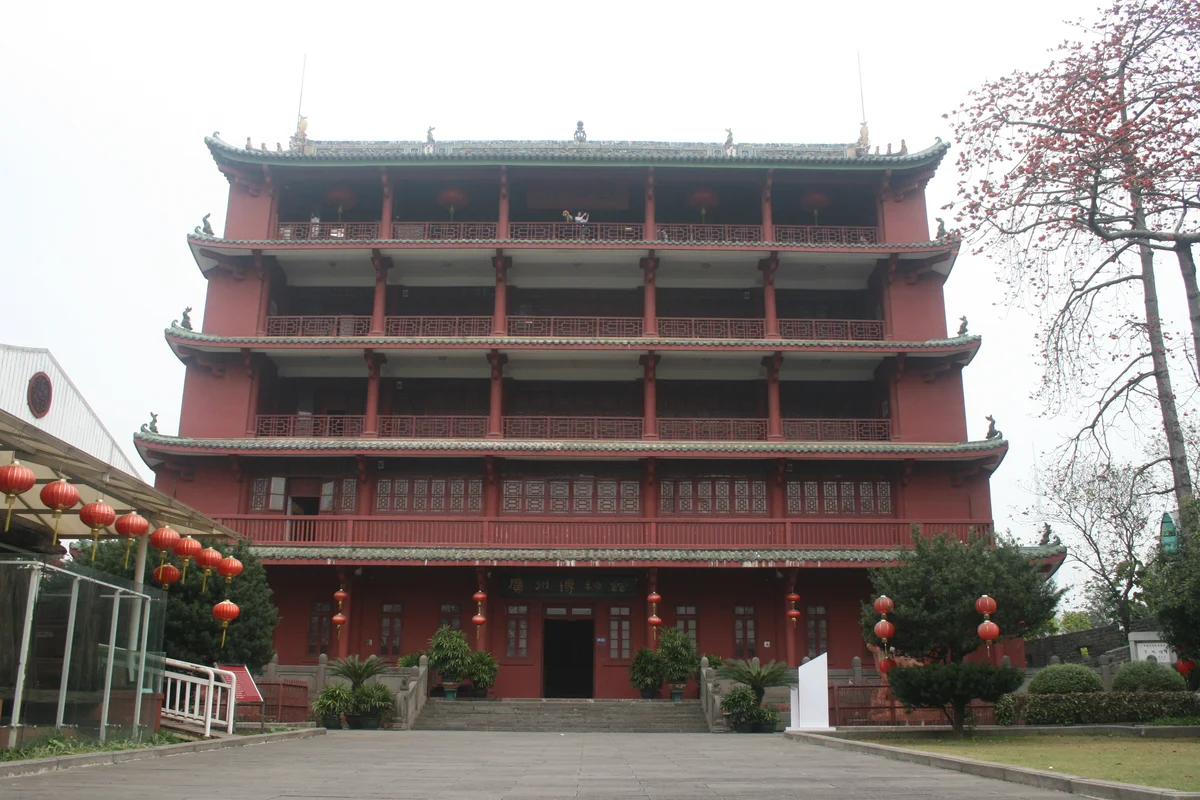
Today, the Guangzhou Museum inside houses five thematic exhibition floors chronicling the city's progression from prehistoric pottery and Maritime Silk Road porcelain to Republican trade artifacts. On the stone terrace outside, visitors can inspect a dozen preserved Qing Dynasty coastal defense iron cannons.
Ming Dynasty City Wall: Guangzhou's 600-Year-Old Ramparts
Directly connecting to Zhenhai Tower is the surviving section of the Ming Dynasty City Wall (明代古城墙). Built in 1380 to unify three separate Song Dynasty walled towns, the fortifications were extended over the rugged crest of Yuexiu Mountain to ensure complete artillery coverage.
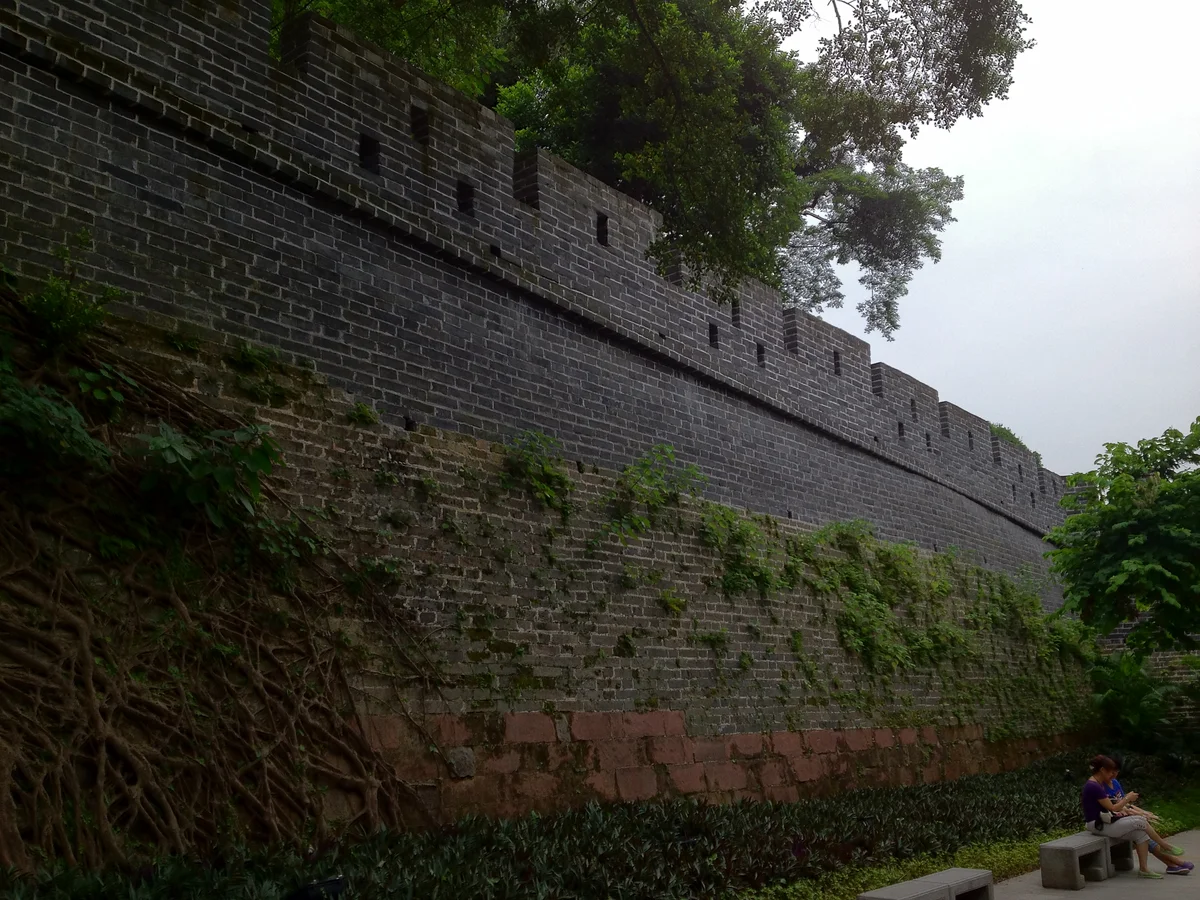
Measuring 1,137 meters in length, this is the only remaining stretch of medieval city wall in Guangzhou. The wall features a base of red sandstone blocks quarried from the Lianhua Mountain quarries, topped by heavy kilned grey bricks and crenellated battlements. Twisted banyan aerial roots have wrapped around the centuries-old masonry, creating an evocative living relic of Guangzhou's ancient defensive boundary.
Sun Yat-sen Monument and the Historic Central Axis
On the southern peak of Guanyin Hill stands the monumental Sun Yat-sen Monument (中山纪念碑). Designed by visionary architect Lü Yanzhi and completed in 1929, this 37-meter-tall granite obelisk commemorates Dr. Sun Yat-sen's pivotal role in founding the Republic of China.
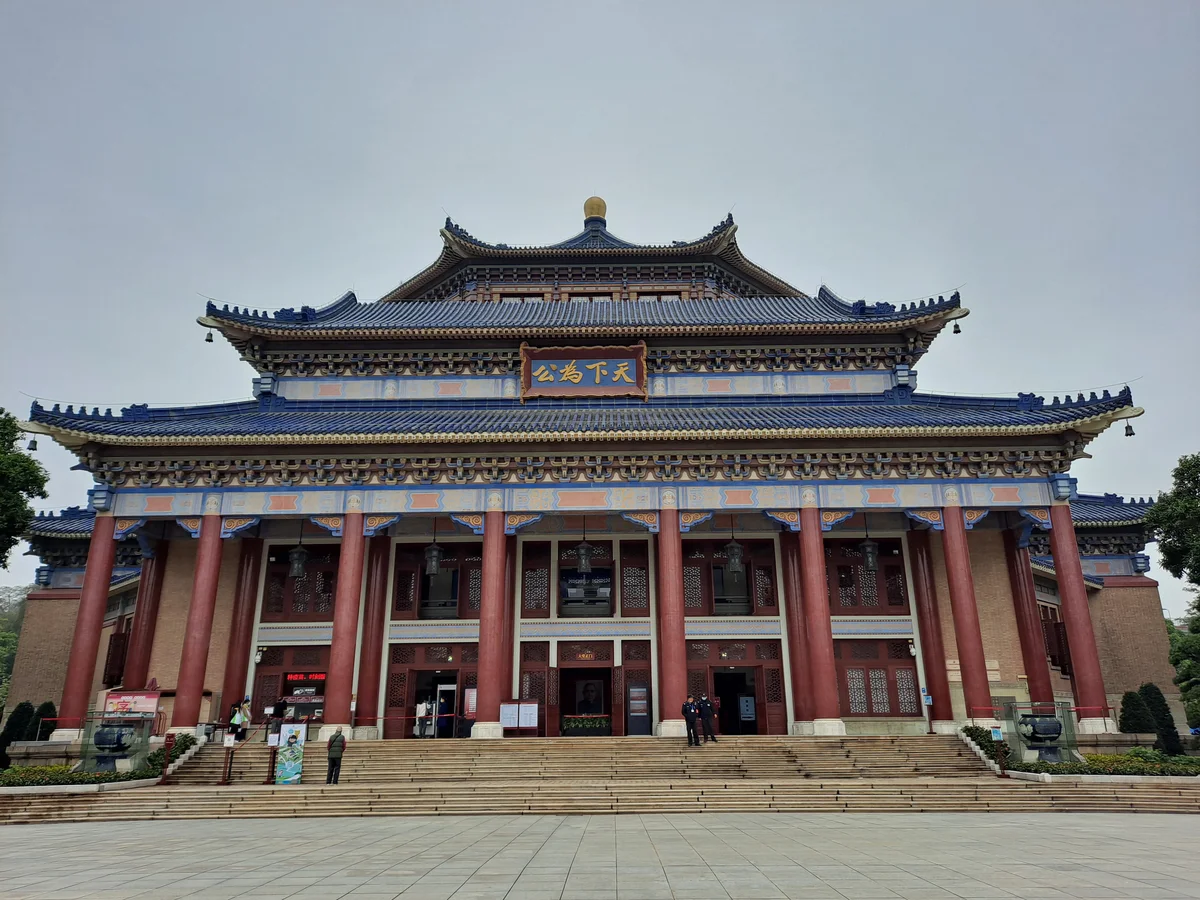
Lü Yanzhi aligned the mountain obelisk along a precise celestial meridian connecting down to the octagonal dome of Sun Yat-sen Memorial Hall, the Guangzhou Municipal Government Compound, People's Park, and Sacred Heart Cathedral across the Pearl River. The monument's north face features a massive white marble tablet engraved with Sun Yat-sen's political testament handwritten by General Li Jishen. Visitors can climb an internal spiral stone staircase to observation platforms offering panoramic views of Guangzhou's historic central core.
Scenic Lakes and Everyday Cantonese Park Life
Beyond its ancient monuments, Yuexiu Park thrives as the beating social heart of everyday Cantonese recreation.
Dongxiu, Nanxiu, and Beixiu Lakes
The park is blessed with three expansive water bodies:
- Beixiu Lake (North Lake): The largest body of water, offering pedal-boat and electric boat rentals where families glide beneath arched bridges and weeping willows.
- Nanxiu Lake (South Lake): Known for its expansive lawns and open vistas toward the Zhenhai Tower ridge, frequently used for outdoor watercolor painting and kite-flying.
- Dongxiu Lake (East Lake): A tranquil pond bordered by the Guangzhou Art Museum's classical gardens, stone pavilions, and swimming facilities.
Morning Dim Sum, Cantonese Opera Choirs, and Tai Chi
Arrive between 7:00 AM and 9:30 AM to witness authentic Cantonese civic culture. Retirees gather along shaded stone arcades carrying caged songbirds, practicing sword dance, and performing group tai chi. Beside the lake pavilions, amateur Cantonese opera troupes bring their own gaohu (fiddles) and pipas, singing operatic duets to delighted onlookers. A morning stroll here pairs perfectly with traditional Cantonese morning dim sum at the park's historic lakeside teahouse, Panxi Restaurant, or local eateries along Jiefang North Road.
Self-Guided Walking Routes and Itineraries
Because Yuexiu Park features multiple entrance gates linked by stepped paths and gentle forest roads, following a structured itinerary helps avoid redundant uphill climbs.
The Classic 2.5-Hour Heritage Trail
- Start at Park West Gate (Yuexiu Park Metro Station, Exit B1): Enter the park and climb the shaded steps of Muke Hill to photograph the Five Rams Sculpture.
- Cross Over to the Ming City Wall: Follow the forested ridge walkway eastward, inspecting the red sandstone battlements and overgrown banyan root systems.
- Tour Zhenhai Tower & Guangzhou Museum: Enter the historic five-story tower (admission: 10 RMB) to view historical Guangzhou exhibits and take in 360-degree vistas from the top floor.
- Ascend Sun Yat-sen Monument: Walk south along the stone ridge toward Guanyin Hill to inspect the 37-meter granite obelisk.
- Exit via South Gate toward Sun Yat-sen Memorial Hall: Descend the south stairs directly into the gardens of the Sun Yat-sen Memorial Hall and Metro Line 2.
Photography Spots and Sunset Timing
- Five Rams Sculpture: Shoot from the south plaza looking upward between 8:30 AM and 10:00 AM, when morning sunlight illuminates the ram's golden wheat stalk against blue skies.
- Zhenhai Tower: Stand on the east stone terrace near the iron cannons between 3:30 PM and 5:00 PM for warm golden-hour lighting across the red brickwork.
- Beixiu Lake Bridge: Capture reflections of surrounding palm trees and mountain ridges during calm mid-morning hours.
Practical Travel Information: Metro, Hours, and Nearby Sights
| Detail | Information |
|---|---|
| Park Admission | Free (All park gates, trails, and public gardens) |
| Museum Admission | Zhenhai Tower / Guangzhou Museum: 10 RMB (Concessions: 5 RMB) |
| Opening Hours | Park grounds: 6:00 AM – 10:00 PM daily Guangzhou Museum (Zhenhai Tower): 9:00 AM – 5:30 PM (Closed Mondays, last entry 5:00 PM) |
| Suggested Duration | 2 to 3.5 hours |
How to Get to Yuexiu Park by Metro
Yuexiu Park is exceptionally easy to access using Guangzhou Metro Line 2:
- Yuexiu Park Station (Line 2, Exit B1): Opens directly onto the Park West Gate / Main Plaza, perfect for starting the Five Rams walking trail.
- Sun Yat-sen Memorial Hall Station (Line 2, Exit C): Exit toward the Sun Yat-sen Memorial Hall and walk 3 minutes north to enter through the Park South Gate.
Nearby Cultural Attractions in Yuexiu District
Because Yuexiu Park is located at the center of Guangzhou's historical core, it links seamlessly with several top heritage destinations:
- Nanyue King Museum (King's Tomb Section): Located directly across Jiefang North Road from Yuexiu Park's West Gate, this subterranean archaeological museum preserves the 2,100-year-old jade burial shroud and tomb of Western Han ruler Zhao Mo.
- Sun Yat-sen Memorial Hall (中山纪念堂): Located directly south of the park, showcasing an octagonal steel-roofed auditorium built without interior pillars.
- Chen Clan Ancestral Hall (陈家祠): Just three metro stops away via Line 2 to Line 1, celebrated for Qing Dynasty wood, stone, and brick architectural carvings.
- Beijing Road Pedestrian Street: Located 1.5 km southeast, featuring glass-covered underground excavations of Song and Tang dynasty road layers.
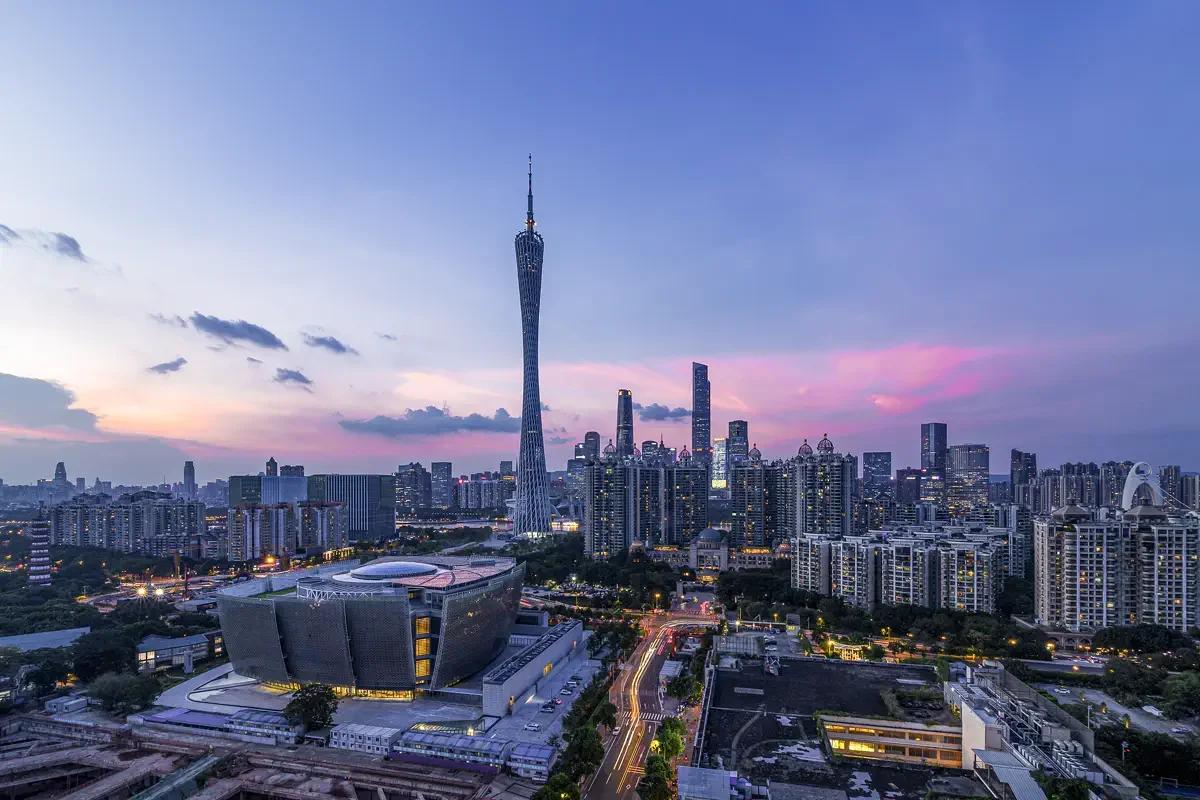
- Canton Tower & Pearl River Night Cruise: Board an evening cruise from Tianzi Pier to watch Guangzhou's modern skyline illuminate after a day exploring ancient Yuexiu Mountain.
Frequently Asked Questions About Yuexiu Park
Is Yuexiu Park free to enter?
Yes. Entry to Yuexiu Park, its botanical gardens, mountain trails, and the Five Rams Sculpture is completely free 365 days a year. The only paid attraction inside is the Guangzhou Museum housed within Zhenhai Tower (10 RMB admission).
Are there electric sightseeing carts available in Yuexiu Park?
Yes. Open-air electric sightseeing shuttles operate regularly between the main entrance gates, Zhenhai Tower, and the Five Rams Sculpture (approx. 10–15 RMB per ride), making the park accessible for elderly visitors and families with small children.
Is Yuexiu Park suitable for wheelchairs and strollers?
The lower lakeside paths around Beixiu and Nanxiu lakes are flat and paved with smooth concrete and stone. However, climbing up to the Five Rams Sculpture, Zhenhai Tower, and the Sun Yat-sen Monument requires traversing flights of stone steps. Wheelchair users should utilize the paved ring road or electric park shuttles to reach elevated areas.
What is the best season to visit Yuexiu Park?
While the park is green year-round, the best visiting weather occurs from October through April during Guangzhou's mild, dry autumn and winter. Each year during Lunar New Year (January/February), Yuexiu Park hosts the celebrated Yuexiu Spring Lantern Festival, displaying hundreds of illuminated lantern sculptures across the lakes.